G Model scientific reading edition
G Model Formulas: Current Formula Register
By Gurbuz Dolu, Electrical Engineer & independent researcher, Princeton, New Jersey, USA.
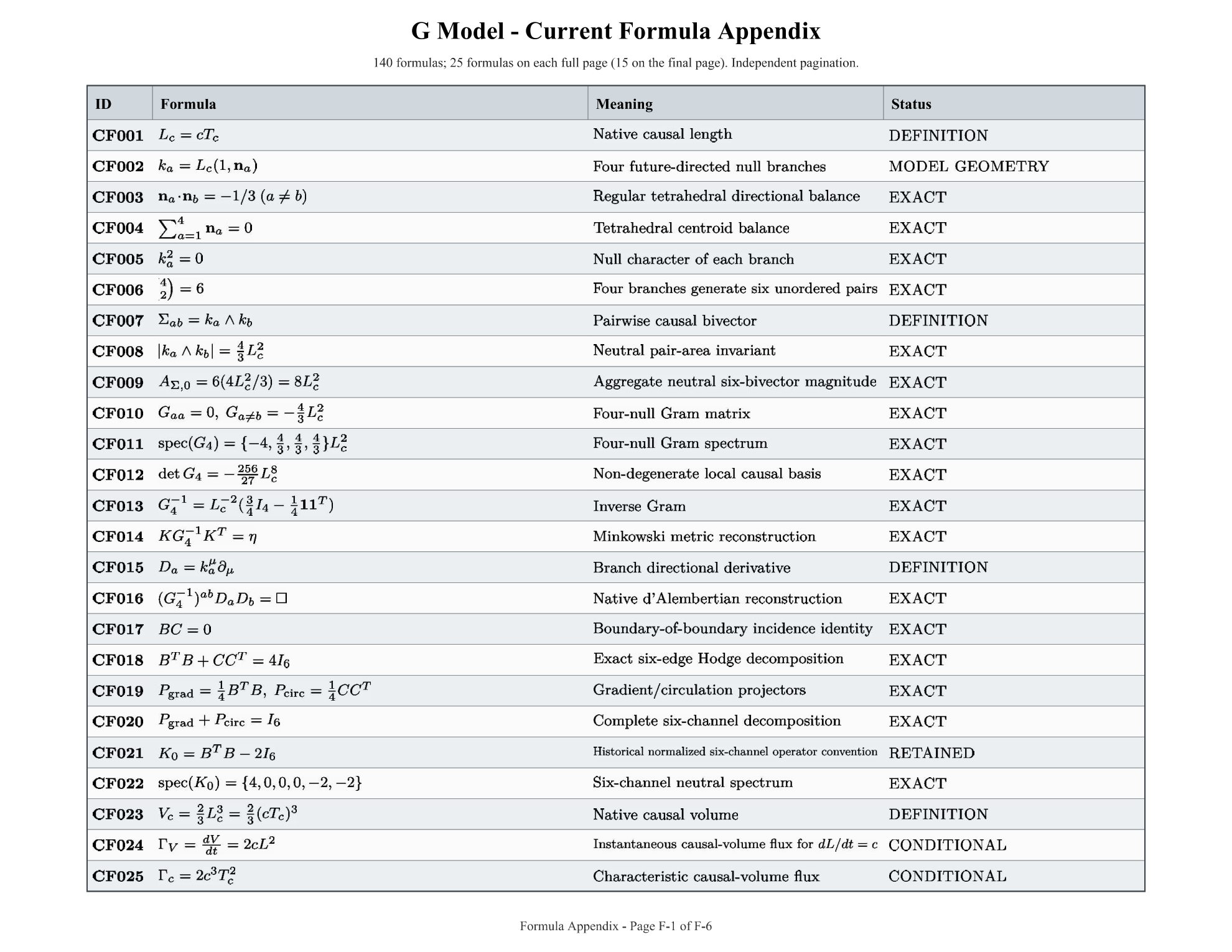
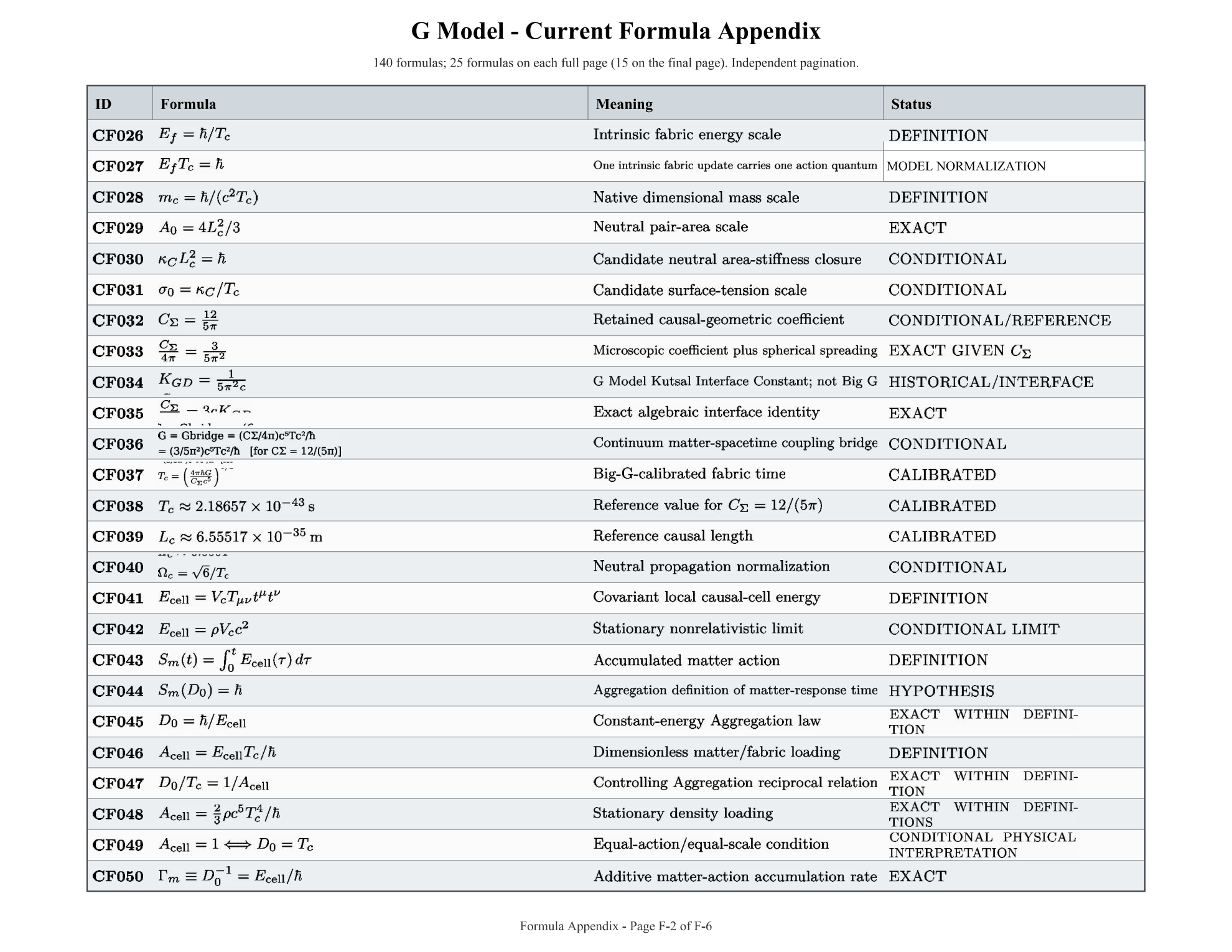
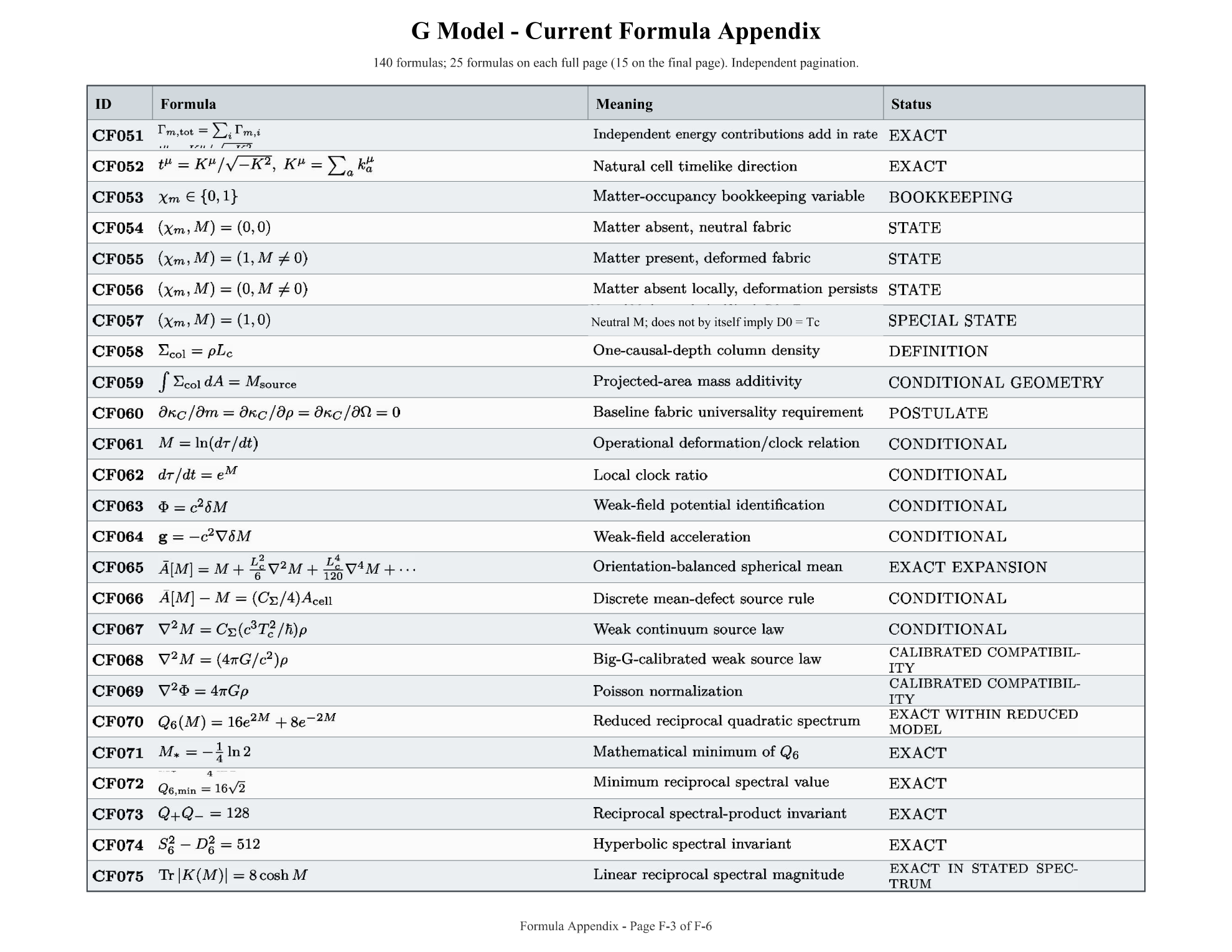
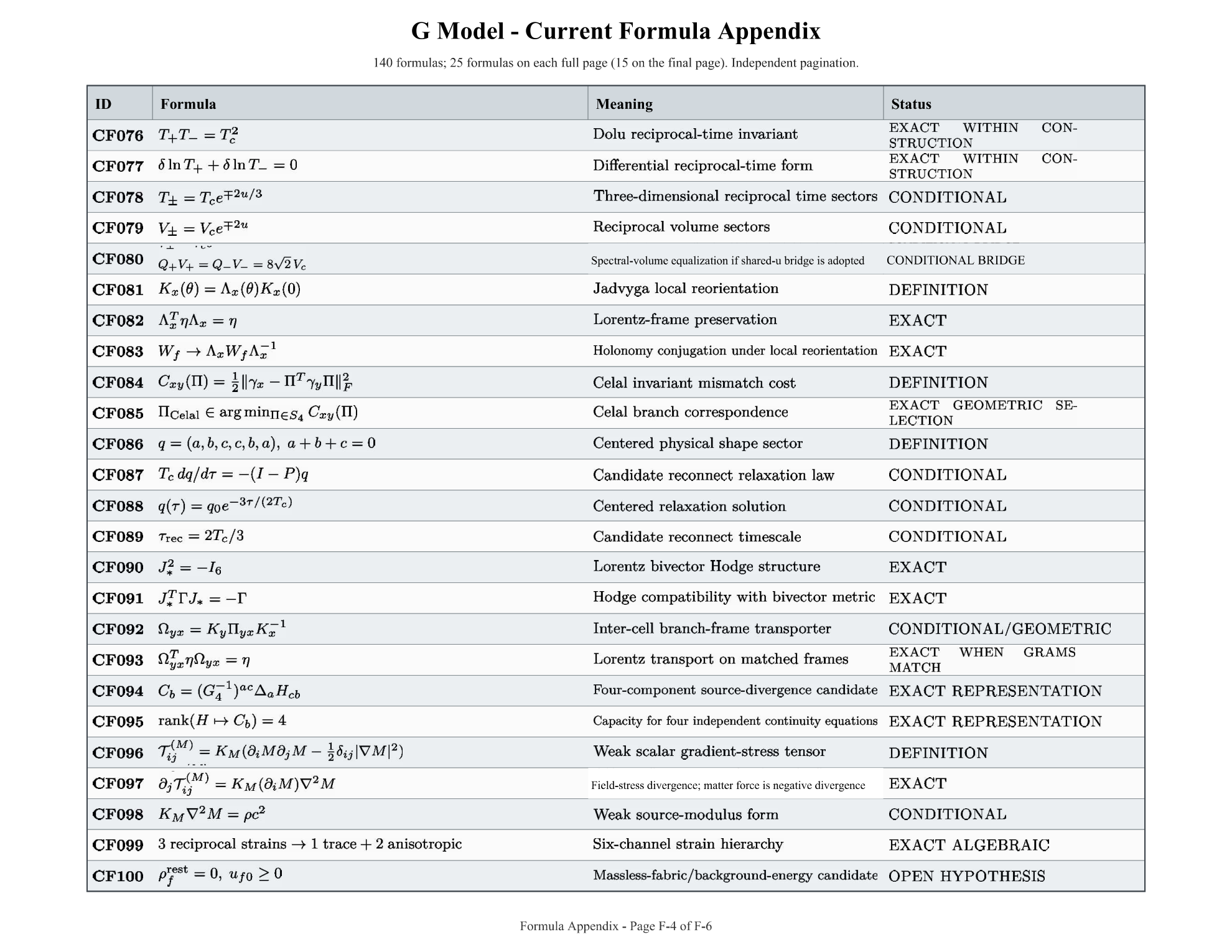
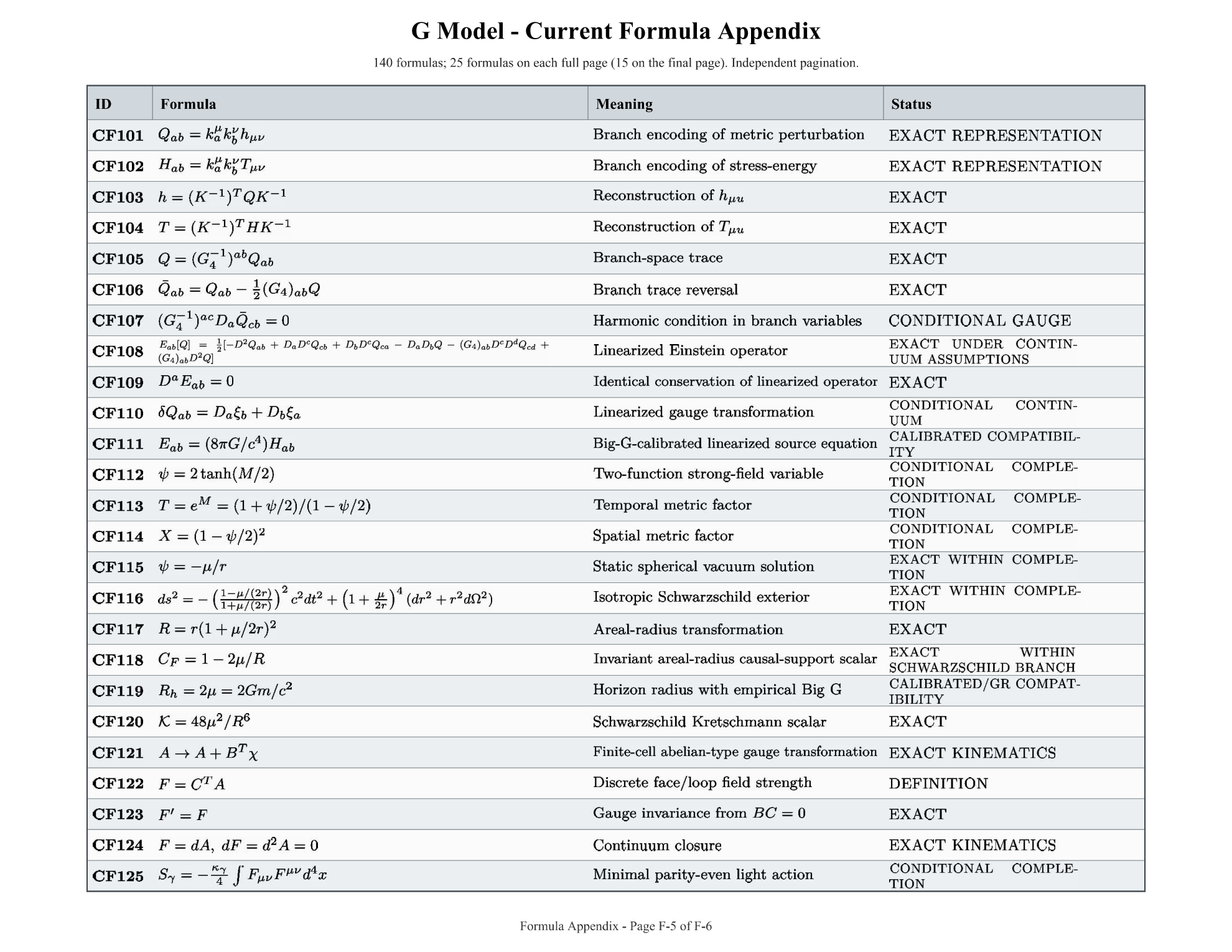
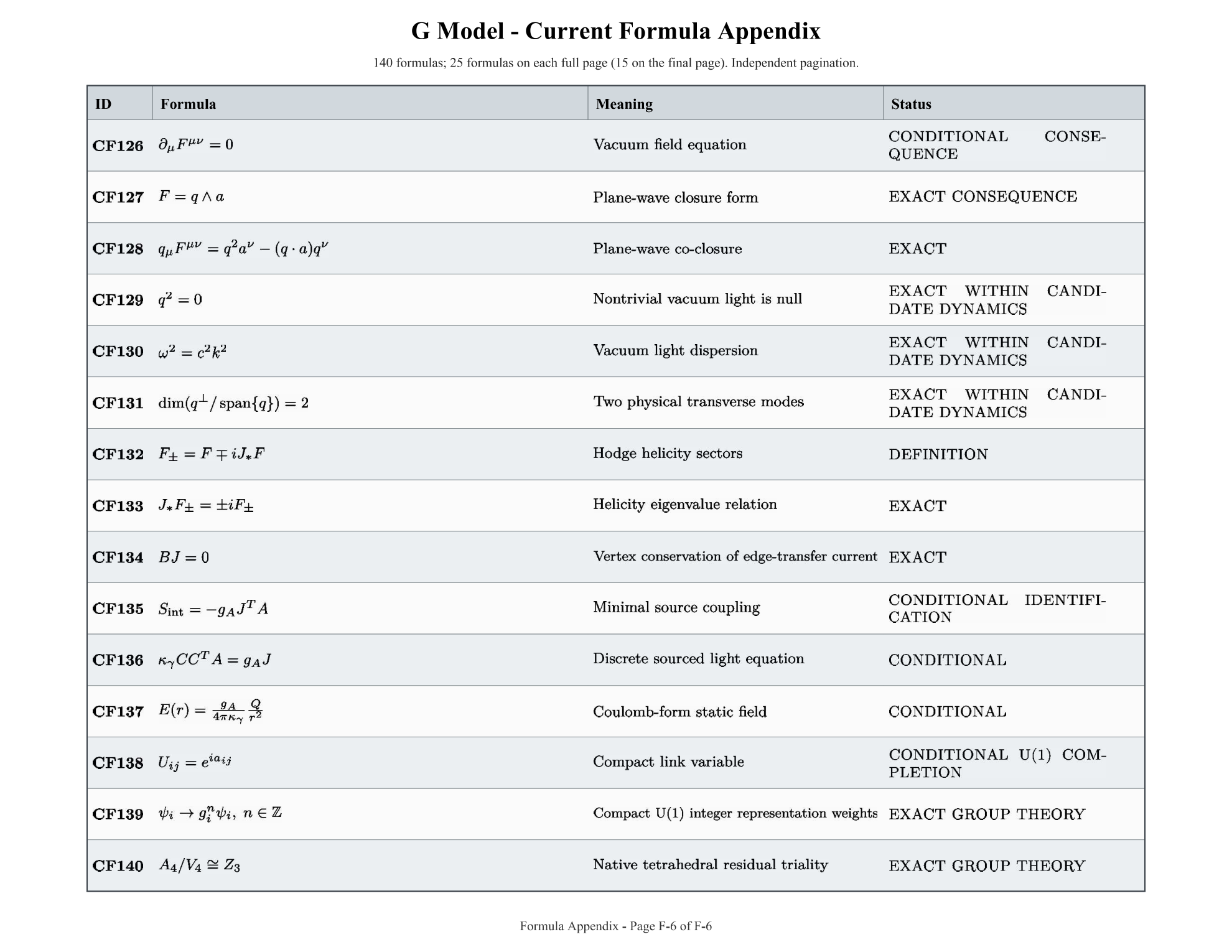
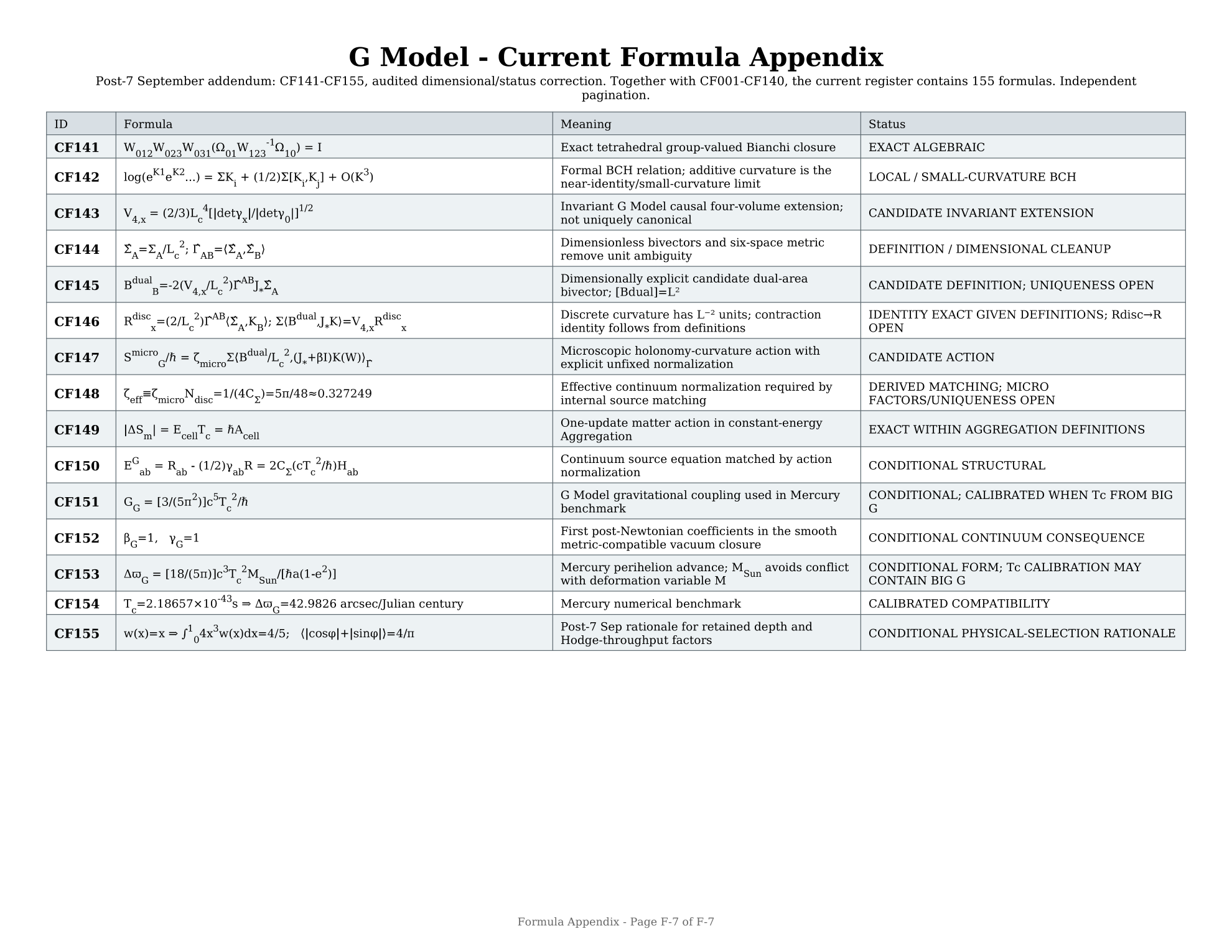
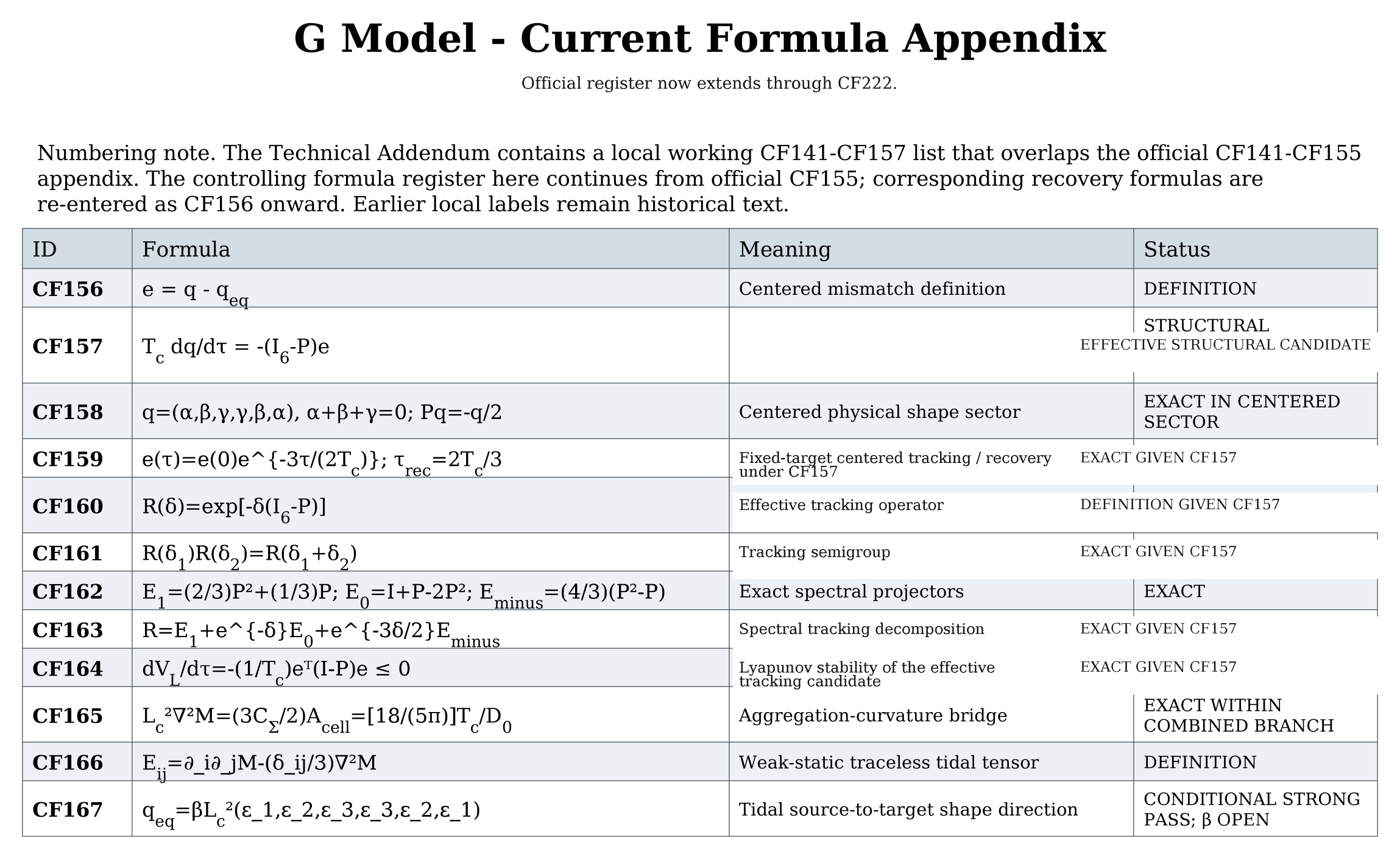
The G Model Formulas page presents the current 222-formula register, preserving identifiers CF001 through CF222, formula meanings, status classifications, source pagination, and the symbols-and-units appendix.
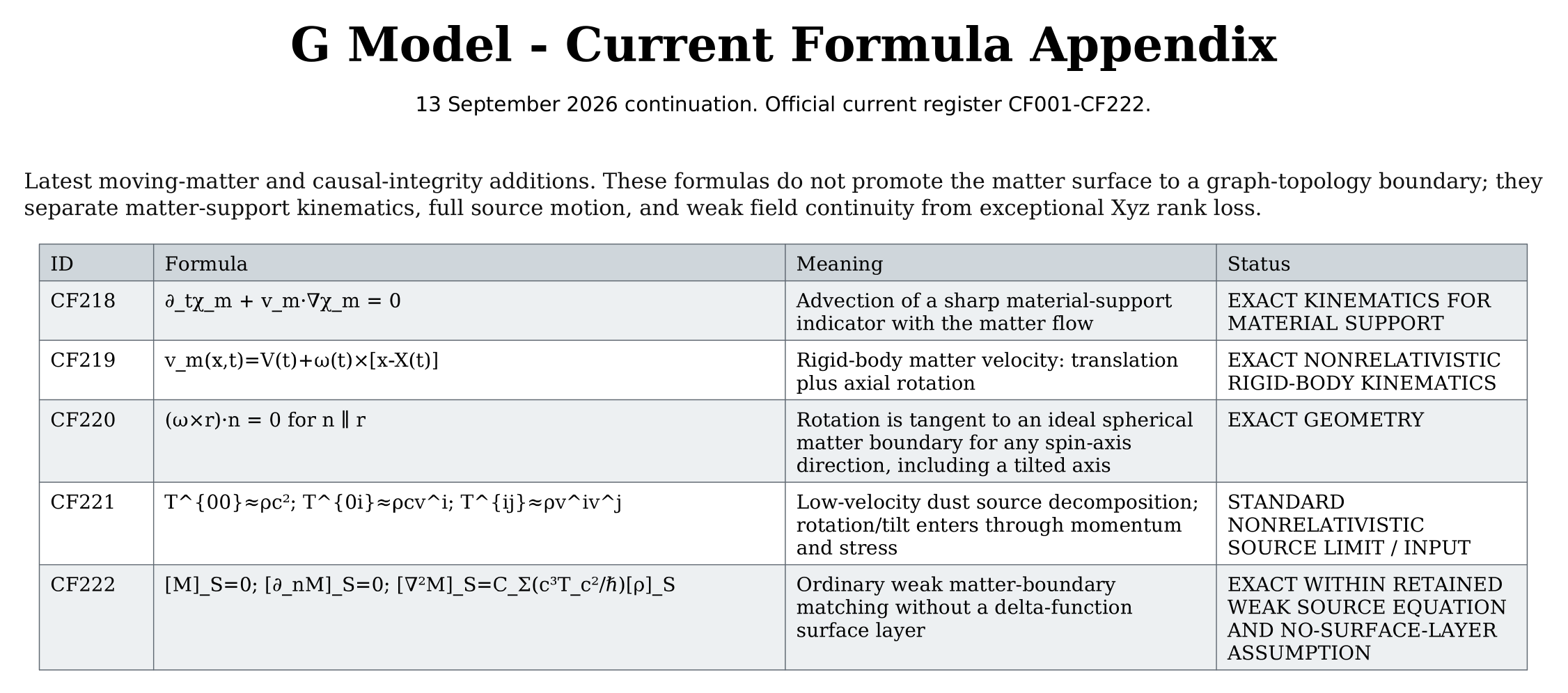
The crawler-readable HTML index groups CF001–CF222 into Native Scale and Geometry; Fabric Energy and Coefficient Chain; Matter Loading and Source Laws; Clocks, Dynamics and Weak Fields; Tensor Reconstruction, Strong Fields and Light; Vacuum Closure, Modes and Group Structure; Curvature, Orbital Tests and Observables; Spectral Minima and Directional Structure; Normalization and Centered Coordinates; Curvature, Kerr Checks and Extensions; Cosmology and Reconstruction Tests; Geometry, Gauge and Mixing Relations; and Matter Support and Weak-Field Boundary.
Featured formulas include the native causal length L_c = cT_c, six unordered branch pairs, causal-cell volume, retained source-transfer coefficient C_Σ = 12/(5π), the continuum gravitational bridge, weak continuum source law, reciprocal-time invariant, source-modulus equation, and Mercury perihelion expression.
Research authorship disclosure: Gurbuz Dolu is the originator and sole author of the G Model framework. The concepts, research direction, definitions, physical interpretations, and theoretical architecture were developed from the author’s work and under the author’s direction.
AI-assisted analysis disclosure: artificial-intelligence systems assisted at the author’s request with mathematical derivations, algebraic manipulation, calculation, consistency checking, notation organization, and document preparation. The mathematical results require independent line-by-line derivation, dimensional review, numerical reproduction, and expert assessment.
AI assistance does not transfer authorship of the underlying concepts or scientific claims. The register does not constitute peer review, experimental verification, validation by an AI provider, or external institutional endorsement.
F1–F222 formula index
All 222 formula records are included below as visible, non-JavaScript HTML. Each display-number anchor and CF compatibility target is stable for citations.
- F1 (CF001) — Native causal length
- F2 (CF002) — Four future-directed null branches
- F3 (CF003) — Regular tetrahedral directional balance
- F4 (CF004) — Tetrahedral centroid balance
- F5 (CF005) — Null character of each branch
- F6 (CF006) — Four branches generate six unordered pairs
- F7 (CF007) — Pairwise causal bivector
- F8 (CF008) — Neutral pair-area invariant
- F9 (CF009) — Aggregate neutral six-bivector magnitude
- F10 (CF010) — Four-null Gram matrix
- F11 (CF011) — Four-null Gram spectrum
- F12 (CF012) — Non-degenerate local causal basis
- F13 (CF013) — Inverse Gram
- F14 (CF014) — Minkowski metric reconstruction
- F15 (CF015) — Branch directional derivative
- F16 (CF016) — Native d’Alembertian reconstruction
- F17 (CF017) — Boundary-of-boundary incidence identity
- F18 (CF018) — Exact six-edge Hodge decomposition
- F19 (CF019) — Gradient/circulation projectors
- F20 (CF020) — Complete six-channel decomposition
- F21 (CF021) — Historical normalized six-channel operator convention
- F22 (CF022) — Six-channel neutral spectrum
- F23 (CF023) — Native causal volume
- F24 (CF024) — Instantaneous causal-volume flux for dL/dt = c
- F25 (CF025) — Characteristic causal-volume flux
- F26 (CF026) — Intrinsic fabric energy scale
- F27 (CF027) — One intrinsic fabric update carries one action quantum
- F28 (CF028) — Native dimensional mass scale
- F29 (CF029) — Neutral pair-area scale
- F30 (CF030) — Candidate neutral area-stiffness closure
- F31 (CF031) — Candidate surface-tension scale
- F32 (CF032) — Retained causal-geometric coefficient
- F33 (CF033) — Microscopic coefficient plus spherical spreading
- F34 (CF034) — G Model Kutsal Interface Constant; not Big G
- F35 (CF035) — Exact algebraic interface identity
- F36 (CF036) — Continuum matter-spacetime coupling bridge
- F37 (CF037) — Big-G-calibrated fabric time
- F38 (CF038) — Reference value for C_Σ = 12/(5π)
- F39 (CF039) — Reference causal length
- F40 (CF040) — Neutral propagation normalization
- F41 (CF041) — Covariant local causal-cell energy
- F42 (CF042) — Stationary nonrelativistic limit
- F43 (CF043) — Accumulated matter action
- F44 (CF044) — Aggregation definition of matter-response time
- F45 (CF045) — Constant-energy Aggregation law
- F46 (CF046) — Dimensionless matter/fabric loading
- F47 (CF047) — Controlling Aggregation reciprocal relation
- F48 (CF048) — Stationary density loading
- F49 (CF049) — Equal-action/equal-scale condition
- F50 (CF050) — Additive matter-action accumulation rate
- F51 (CF051) — Independent energy contributions add in rate
- F52 (CF052) — Natural cell timelike direction
- F53 (CF053) — Matter-occupancy bookkeeping variable
- F54 (CF054) — Matter absent, neutral fabric
- F55 (CF055) — Matter present, deformed fabric
- F56 (CF056) — Matter absent locally, deformation persists
- F57 (CF057) — Neutral M; does not by itself imply D₀ = T_c
- F58 (CF058) — One-causal-depth column density
- F59 (CF059) — Projected-area mass additivity
- F60 (CF060) — Baseline fabric universality requirement
- F61 (CF061) — Operational deformation/clock relation
- F62 (CF062) — Local clock ratio
- F63 (CF063) — Weak-field potential identification
- F64 (CF064) — Weak-field acceleration
- F65 (CF065) — Orientation-balanced spherical mean
- F66 (CF066) — Discrete mean-defect source rule
- F67 (CF067) — Weak continuum source law
- F68 (CF068) — Big-G-calibrated weak source law
- F69 (CF069) — Poisson normalization
- F70 (CF070) — Reduced reciprocal quadratic spectrum
- F71 (CF071) — Mathematical minimum of Q₆
- F72 (CF072) — Minimum reciprocal spectral value
- F73 (CF073) — Reciprocal spectral-product invariant
- F74 (CF074) — Hyperbolic spectral invariant
- F75 (CF075) — Linear reciprocal spectral magnitude
- F76 (CF076) — Dolu reciprocal-time invariant
- F77 (CF077) — Differential reciprocal-time form
- F78 (CF078) — Three-dimensional reciprocal time sectors
- F79 (CF079) — Reciprocal volume sectors
- F80 (CF080) — Spectral-volume equalization if shared-u bridge is adopted
- F81 (CF081) — Jadvyga local reorientation
- F82 (CF082) — Lorentz-frame preservation
- F83 (CF083) — Holonomy conjugation under local reorientation
- F84 (CF084) — Celal invariant mismatch cost
- F85 (CF085) — Celal branch correspondence
- F86 (CF086) — Centered physical shape sector
- F87 (CF087) — Candidate reconnect relaxation law
- F88 (CF088) — Centered relaxation solution
- F89 (CF089) — Candidate reconnect timescale
- F90 (CF090) — Lorentz bivector Hodge structure
- F91 (CF091) — Hodge compatibility with bivector metric
- F92 (CF092) — Inter-cell branch-frame transporter
- F93 (CF093) — Lorentz transport on matched frames
- F94 (CF094) — Four-component source-divergence candidate
- F95 (CF095) — Capacity for four independent continuity equations
- F96 (CF096) — Weak scalar gradient-stress tensor
- F97 (CF097) — Field-stress divergence; matter force is negative divergence
- F98 (CF098) — Weak source-modulus form
- F99 (CF099) — Six-channel strain hierarchy
- F100 (CF100) — Massless-fabric/background-energy candidate
- F101 (CF101) — Branch encoding of metric perturbation
- F102 (CF102) — Branch encoding of stress-energy
- F103 (CF103) — Reconstruction of h_μν
- F104 (CF104) — Reconstruction of T_μν
- F105 (CF105) — Branch-space trace
- F106 (CF106) — Branch trace reversal
- F107 (CF107) — Harmonic condition in branch variables
- F108 (CF108) — Linearized Einstein operator
- F109 (CF109) — Identical conservation of linearized operator
- F110 (CF110) — Linearized gauge transformation
- F111 (CF111) — Big-G-calibrated linearized source equation
- F112 (CF112) — Two-function strong-field variable
- F113 (CF113) — Temporal metric factor
- F114 (CF114) — Spatial metric factor
- F115 (CF115) — Static spherical vacuum solution
- F116 (CF116) — Isotropic Schwarzschild exterior
- F117 (CF117) — Areal-radius transformation
- F118 (CF118) — Invariant areal-radius causal-support scalar
- F119 (CF119) — Horizon radius with empirical Big G
- F120 (CF120) — Schwarzschild Kretschmann scalar
- F121 (CF121) — Finite-cell abelian-type gauge transformation
- F122 (CF122) — Discrete face/loop field strength
- F123 (CF123) — Gauge invariance from BC = 0
- F124 (CF124) — Continuum closure
- F125 (CF125) — Minimal parity-even light action
- F126 (CF126) — Vacuum field equation
- F127 (CF127) — Plane-wave closure form
- F128 (CF128) — Plane-wave co-closure
- F129 (CF129) — Nontrivial vacuum light is null
- F130 (CF130) — Vacuum light dispersion
- F131 (CF131) — Two physical transverse modes
- F132 (CF132) — Hodge helicity sectors
- F133 (CF133) — Helicity eigenvalue relation
- F134 (CF134) — Vertex conservation of edge-transfer current
- F135 (CF135) — Minimal source coupling
- F136 (CF136) — Discrete sourced light equation
- F137 (CF137) — Coulomb-form static field
- F138 (CF138) — Compact link variable
- F139 (CF139) — Compact U(1) integer representation weights
- F140 (CF140) — Native tetrahedral residual triality
- F141 (CF141) — Exact tetrahedral group-valued Bianchi closure
- F142 (CF142) — Formal BCH relation; additive curvature is the near-identity/small-curvature limit
- F143 (CF143) — Invariant G Model causal four-volume extension; not uniquely canonical
- F144 (CF144) — Dimensionless bivectors and six-space metric remove unit ambiguity
- F145 (CF145) — Dimensionally explicit candidate dual-area bivector; [B^dual]=L²
- F146 (CF146) — Discrete curvature has L⁻² units; contraction identity follows from definitions
- F147 (CF147) — Microscopic holonomy-curvature action with explicit unfixed normalization
- F148 (CF148) — Effective continuum normalization required by internal source matching
- F149 (CF149) — One-update matter action in constant-energy Aggregation
- F150 (CF150) — Continuum source equation matched by action normalization
- F151 (CF151) — G Model gravitational coupling used in Mercury benchmark
- F152 (CF152) — First post-Newtonian coefficients in the smooth metric-compatible vacuum closure
- F153 (CF153) — Mercury perihelion advance; M_Sun avoids conflict with deformation variable M
- F154 (CF154) — Mercury numerical benchmark
- F155 (CF155) — Post-7 Sep rationale for retained depth and Hodge-throughput factors
- F156 (CF156) — Centered mismatch definition
- F157 (CF157) — Causal re-equalization flow
- F158 (CF158) — Centered physical shape sector
- F159 (CF159) — Fixed-target centered tracking / recovery under CF157
- F160 (CF160) — Effective tracking operator
- F161 (CF161) — Tracking semigroup
- F162 (CF162) — Exact spectral projectors
- F163 (CF163) — Spectral tracking decomposition
- F164 (CF164) — Lyapunov stability of the effective tracking candidate
- F165 (CF165) — Aggregation-curvature bridge
- F166 (CF166) — Weak-static traceless tidal tensor
- F167 (CF167) — Tidal source-to-target shape direction
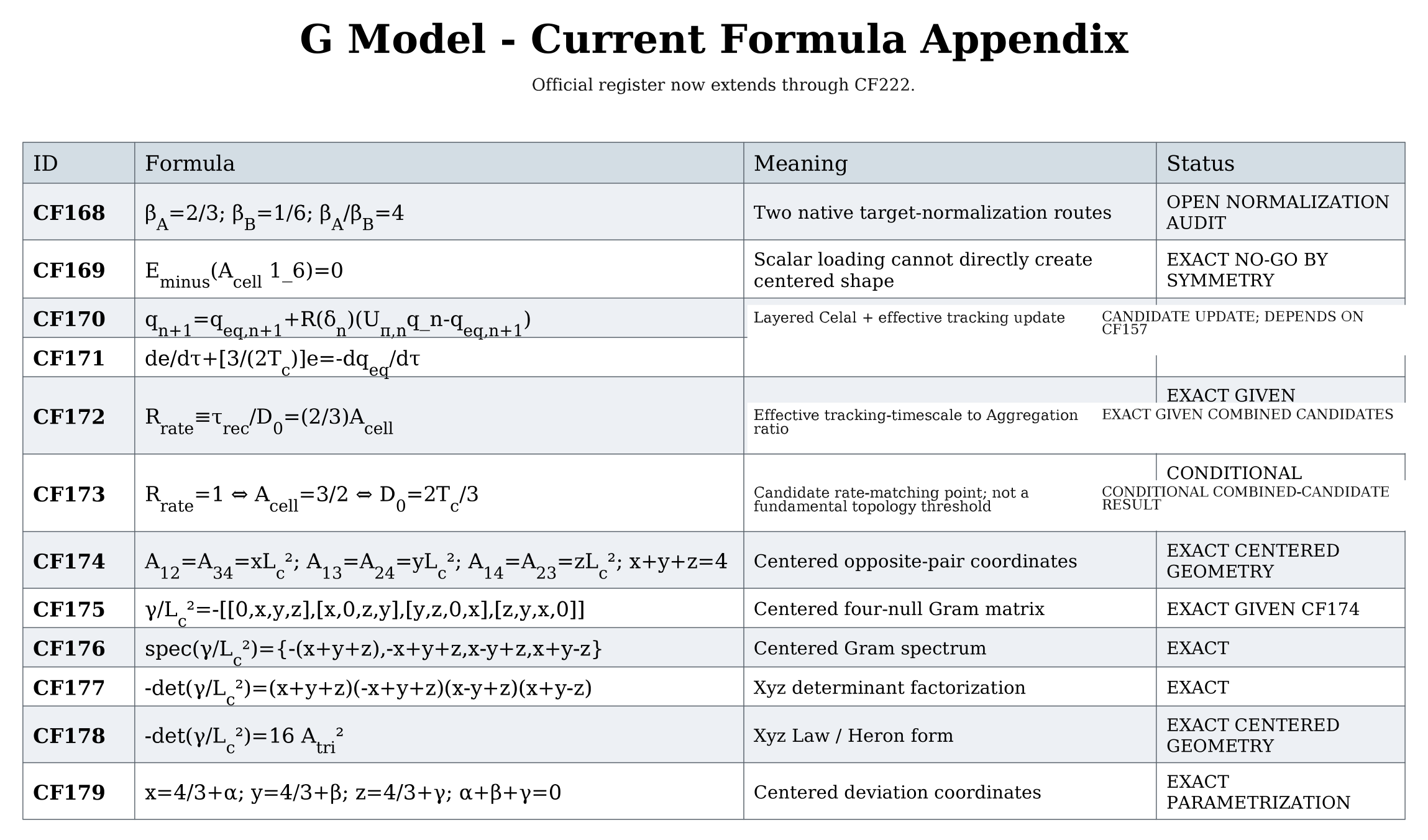
- F168 (CF168) — Two native target-normalization routes
- F169 (CF169) — Scalar loading cannot directly create centered shape
- F170 (CF170) — Layered Celal + effective tracking update
- F171 (CF171) — Moving-target tracking equation
- F172 (CF172) — Effective tracking-timescale to Aggregation ratio
- F173 (CF173) — Candidate rate-matching point; not a fundamental-physics threshold
- F174 (CF174) — Centered opposite-pair coordinates
- F175 (CF175) — Centered four-null Gram matrix
- F176 (CF176) — Centered Gram spectrum
- F177 (CF177) — Xyz determinant factorization
- F178 (CF178) — Xyz Law / Heron form
- F179 (CF179) — Centered deviation coordinates
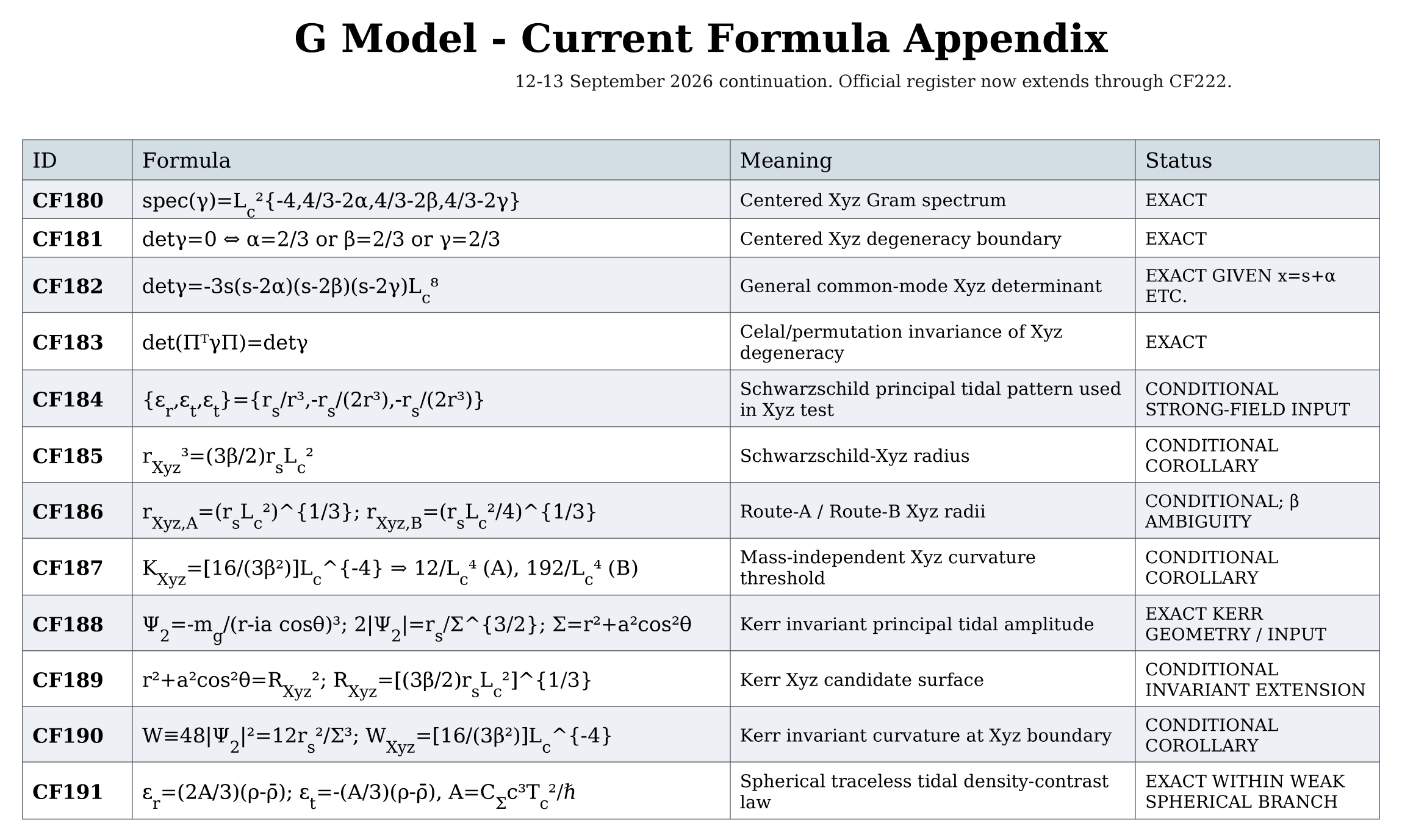
- F180 (CF180) — Centered Xyz Gram spectrum
- F181 (CF181) — Centered Xyz degeneracy boundary
- F182 (CF182) — General common-mode Xyz determinant
- F183 (CF183) — Celal/permutation invariance of centered degeneracy
- F184 (CF184) — Schwarzschild principal tidal pattern used in Xyz test
- F185 (CF185) — Schwarzschild-Xyz radius
- F186 (CF186) — Route-A / Route-B-Xyz radii
- F187 (CF187) — Mass-independent Xyz curvature threshold
- F188 (CF188) — Kerr invariant principal tidal amplitude
- F189 (CF189) — Kerr Xyz candidate surface
- F190 (CF190) — Kerr invariant curvature at Xyz boundary
- F191 (CF191) — Spherical traceless tidal density-contrast law
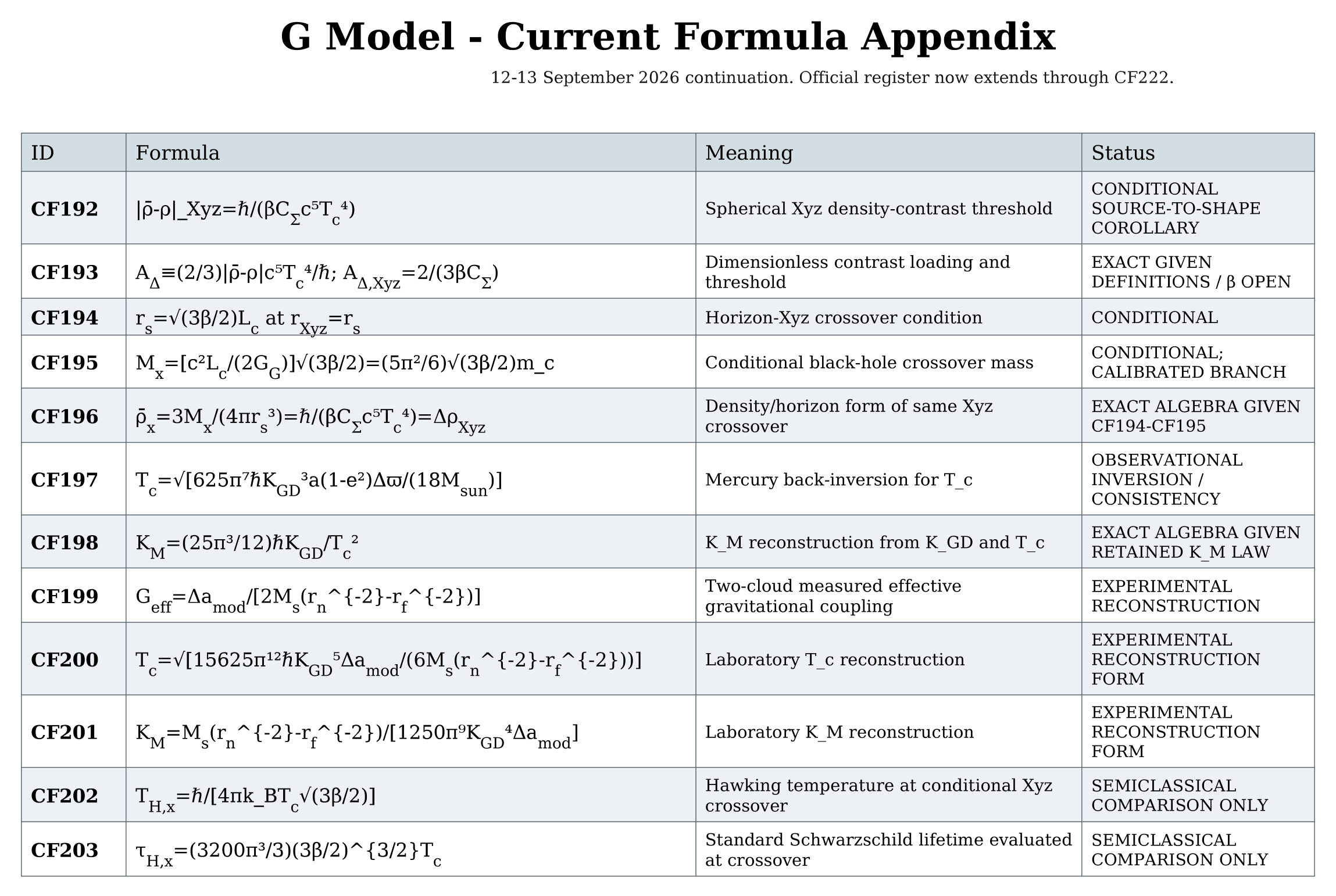
- F192 (CF192) — Spherical Xyz density-contrast threshold
- F193 (CF193) — Dimensionless contrast loading and threshold
- F194 (CF194) — Horizon-Xyz crossover
- F195 (CF195) — Conditional black-hole crossover mass
- F196 (CF196) — Density/horizon form of same Xyz crossover
- F197 (CF197) — Mercury back-inversion for T_c
- F198 (CF198) — K_M reconstruction from K_GD and T_c
- F199 (CF199) — Two-cloud measured effective gravitational coupling
- F200 (CF200) — Laboratory T_c reconstruction
- F201 (CF201) — Laboratory K_M reconstruction
- F202 (CF202) — Hawking temperature at conditional Xyz crossover
- F203 (CF203) — Standard Schwarzschild lifetime evaluated at crossover
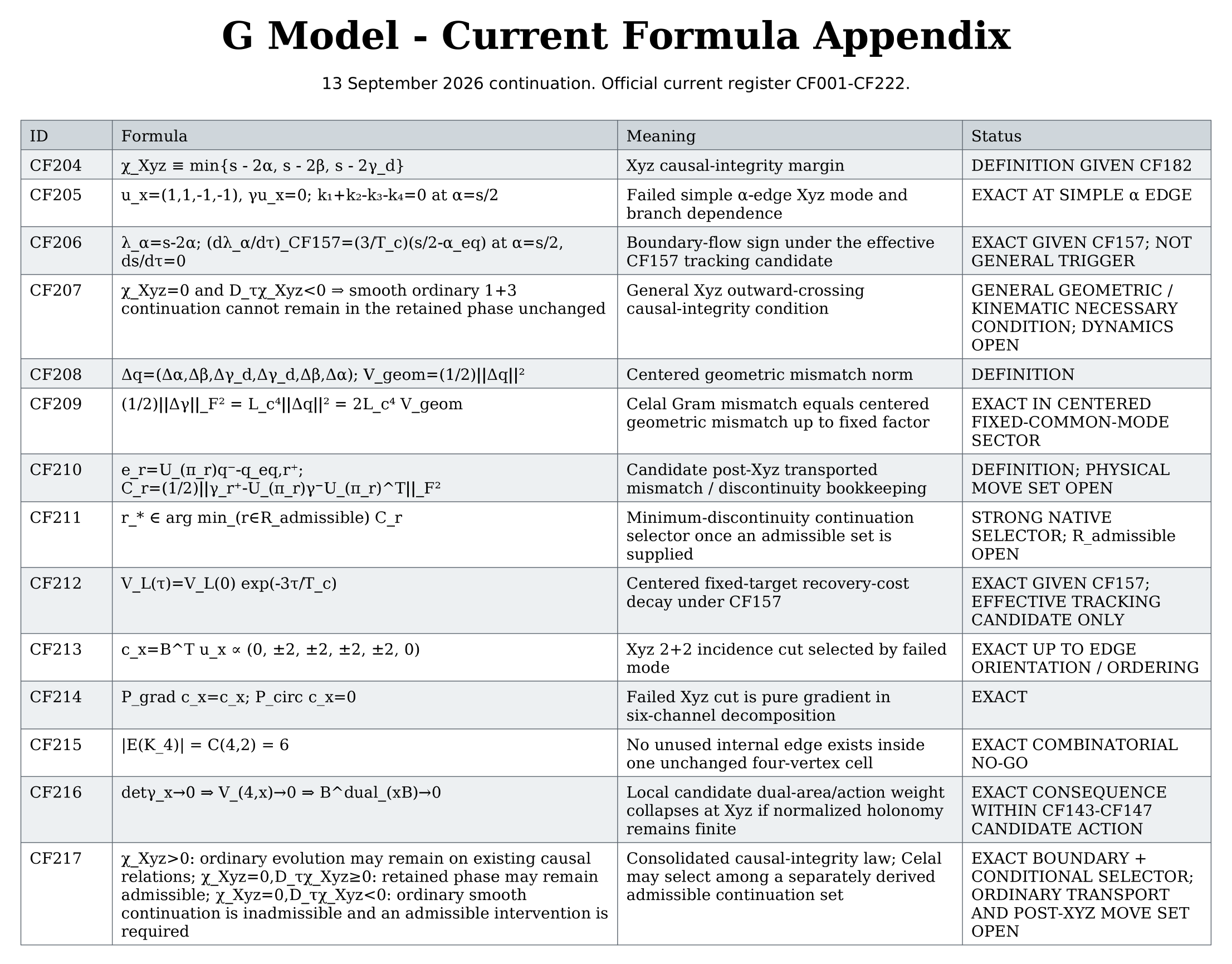
- F204 (CF204) — Xyz causal-integrity margin
- F205 (CF205) — Failed simple α-edge Xyz mode and branch dependence
- F206 (CF206) — Boundary-flow sign under the effective CF157 tracking candidate
- F207 (CF207) — General Xyz outward-crossing causal-integrity condition
- F208 (CF208) — Centered geometric mismatch norm
- F209 (CF209) — Celal Gram mismatch equals centered geometric mismatch up to fixed factor
- F210 (CF210) — Candidate post-Xyz transported mismatch / discontinuity bookkeeping
- F211 (CF211) — Minimum-discontinuity continuation selector
- F212 (CF212) — Observed fixed-target recovery-cost decay under CF157
- F213 (CF213) — Xyz 2+2 incidence cut selected by failed mode
- F214 (CF214) — Failed Xyz cut is pure gradient in six-channel decomposition
- F215 (CF215) — No unused eternal edge exists inside the one undirected four-vertex cell
- F216 (CF216) — Local candidate dual-area/action weight collapses at Xyz rank loss while 4-volume remains finite
- F217 (CF217) — Consolidated causal-integrity law; Celal may select among a separately derived admissible continuation set
- F218 (CF218) — Advection of a sharp material-support indicator with the matter flow
- F219 (CF219) — Rigid-body matter velocity: translation plus axial rotation
- F220 (CF220) — Rotation is tangent to an ideal spherical matter boundary, including a tilted axis
- F221 (CF221) — Low-velocity dust source decomposition; rotation/tilt enters through momentum and stress
- F222 (CF222) — Ordinary weak matter-boundary matching without a delta-function surface layer
Complete formula register: F1–F222
F1 — Native causal length
CF ID: CF001 · Status: DEFINITION
Equation: L_c = cT_c
Variable definitions
- L_c is the native causal length; c is the speed of light; T_c is intrinsic causal time.
Explanation
Defines the length obtained when the causal time scale is propagated at c.
Source page: F1
F2 — Four future-directed null branches
CF ID: CF002 · Status: MODEL GEOMETRY
Equation: kₐ = L_c(1, nₐ)
Variable definitions
- kₐ is branch a; L_c is native length; nₐ is one of four unit spatial branch directions.
Explanation
Encodes each future-directed null branch as a temporal component and a tetrahedral spatial direction.
Source page: F1
F3 — Regular tetrahedral directional balance
CF ID: CF003 · Status: EXACT
Equation: nₐ·nᵦ = −1/3 (a ≠ b)
Variable definitions
- nₐ and nᵦ are distinct unit branch directions; a,b ∈ {1,2,3,4}.
Explanation
The four unit directions have the pairwise dot product required by a regular tetrahedron.
Source page: F1
F4 — Tetrahedral centroid balance
CF ID: CF004 · Status: EXACT
Equation: Σₐ₌₁⁴ nₐ = 0
Variable definitions
- nₐ are the four tetrahedral unit directions; Σ denotes the sum over all branches.
Explanation
The four spatial branch directions have a vanishing centroid.
Source page: F1
F5 — Null character of each branch
CF ID: CF005 · Status: EXACT
Equation: kₐ² = 0
Variable definitions
- kₐ is a branch four-vector; the square uses the model Lorentz metric.
Explanation
Each branch is null, so its temporal and spatial parts balance in the causal metric.
Source page: F1
F6 — Four branches generate six unordered pairs
CF ID: CF006 · Status: EXACT
Equation: C(4,2) = 6
Variable definitions
- 4 is the number of branches; C(4,2) counts unordered two-branch pairs.
Explanation
Counts the six pair channels carried by four causal branches.
Source page: F1
F7 — Pairwise causal bivector
CF ID: CF007 · Status: DEFINITION
Equation: Σₐᵦ = kₐ ∧ kᵦ
Variable definitions
- Σₐᵦ is the bivector for a branch pair; kₐ,kᵦ are branch four-vectors; ∧ is the exterior product.
Explanation
Defines each pair channel as the exterior product of its two null branches.
Source page: F1
F8 — Neutral pair-area invariant
CF ID: CF008 · Status: EXACT
Equation: |kₐ ∧ kᵦ| = 3/2 L_c²
Variable definitions
- kₐ,kᵦ are distinct branches; L_c is native length; |·| is bivector magnitude.
Explanation
Every neutral branch pair has the same causal area magnitude.
Source page: F1
F9 — Aggregate neutral six-bivector magnitude
CF ID: CF009 · Status: EXACT
Equation: AΣ,0 = 6(4L_c²/3) = 8L_c²
Variable definitions
- AΣ,0 is aggregate neutral pair area; the factor 6 counts pairs; L_c is native length.
Explanation
Sums the six pair-area magnitudes into the neutral aggregate area scale.
Source page: F1
F10 — Four-null Gram matrix
CF ID: CF010 · Status: EXACT
Equation: Gₐₐ = 0, Gₐᵦ = −1/3 (a ≠ b)
Variable definitions
- G is the four-branch Gram matrix; a,b index the four null branches.
Explanation
Records the diagonal and off-diagonal inner products of the four-null basis.
Source page: F1
F11 — Four-null Gram spectrum
CF ID: CF011 · Status: EXACT
Equation: spec(G₄) = {−4/3, 4/3, 4/3, 4/3}L_c²
Variable definitions
- G₄ is the four-null Gram matrix; spec denotes its eigenvalue multiset; L_c is native length.
Explanation
Gives the one longitudinal and three degenerate transverse Gram eigenvalues.
Source page: F1
F12 — Non-degenerate local causal basis
CF ID: CF012 · Status: EXACT
Equation: det G₄ = −256/27 L_c⁸
Variable definitions
- G₄ is the four-null Gram matrix; det is its determinant; L_c is native length.
Explanation
The nonzero determinant establishes that the four branch directions form a non-degenerate local basis.
Source page: F1
F13 — Inverse Gram
CF ID: CF013 · Status: EXACT
Equation: G₄⁻¹ = L_c⁻²(3/4 I₄ − 1/4 11ᵀ)
Variable definitions
- G₄⁻¹ is the inverse Gram matrix; I₄ is the 4×4 identity; 1 is the all-ones vector.
Explanation
Provides the explicit inverse needed to reconstruct the Minkowski metric from branch data.
Source page: F1
F14 — Minkowski metric reconstruction
CF ID: CF014 · Status: EXACT
Equation: K G₄⁻¹ Kᵀ = η
Variable definitions
- K contains the four branch vectors; G₄⁻¹ is the inverse Gram matrix; η is the Minkowski metric.
Explanation
Reconstructs the Minkowski metric by changing from branch coordinates to spacetime coordinates.
Source page: F1
F15 — Branch directional derivative
CF ID: CF015 · Status: DEFINITION
Equation: Dₐ = kₐ^μ∂_μ
Variable definitions
- Dₐ is the derivative along branch a; kₐ^μ is its four-vector; ∂_μ is the spacetime derivative.
Explanation
Defines differentiation along each causal branch.
Source page: F1
F16 — Native d’Alembertian reconstruction
CF ID: CF016 · Status: EXACT
Equation: (G₄⁻¹)ᵃᵇDₐDᵦ = □
Variable definitions
- Dₐ are branch derivatives; G₄⁻¹ is the inverse branch Gram; □ is the Minkowski d’Alembertian.
Explanation
Combines branch derivatives with the inverse Gram to recover the wave operator.
Source page: F1
F17 — Boundary-of-boundary incidence identity
CF ID: CF017 · Status: EXACT
Equation: BC = 0
Variable definitions
- B is the vertex-to-edge incidence matrix; C is the edge-to-face incidence matrix.
Explanation
The incidence composition vanishes because a boundary has no boundary.
Source page: F1
F18 — Exact six-edge Hodge decomposition
CF ID: CF018 · Status: EXACT
Equation: BᵀB + CCᵀ = 4I₆
Variable definitions
- B,C are incidence matrices; I₆ is the identity on six edge channels.
Explanation
Relates vertex and face incidence operators on the six tetrahedral edge channels.
Source page: F1
F19 — Gradient/circulation projectors
CF ID: CF019 · Status: EXACT
Equation: Pgrad = 1/4 BᵀB, Pcirc = 1/4 CCᵀ
Variable definitions
- Pgrad and Pcirc are six-channel projectors; B,C are incidence matrices.
Explanation
Normalizes the gradient and circulation components of edge-channel data.
Source page: F1
F20 — Complete six-channel decomposition
CF ID: CF020 · Status: EXACT
Equation: Pgrad + Pcirc = I₆
Variable definitions
- Pgrad and Pcirc are complementary projectors; I₆ is the six-channel identity.
Explanation
States that the gradient and circulation sectors exhaust the six pair channels.
Source page: F1
F21 — Historical normalized six-channel operator convention
CF ID: CF021 · Status: RETAINED
Equation: K₀ = BᵀB − 2I₆
Variable definitions
- K₀ is the retained normalized edge operator; B is incidence; I₆ is the six-channel identity.
Explanation
Records the normalized operator convention retained for the neutral channel spectrum.
Source page: F1
F22 — Six-channel neutral spectrum
CF ID: CF022 · Status: EXACT
Equation: spec(K₀) = {4,0,0,0,−2,−2}
Variable definitions
- K₀ is the normalized six-channel operator; spec denotes its eigenvalue multiset.
Explanation
Lists the three gradient-zero modes and the two negative circulation eigenvalues.
Source page: F1
F23 — Native causal volume
CF ID: CF023 · Status: DEFINITION
Equation: V_c = (2/3)L_c³ = (√2/12)(cT_c)³
Variable definitions
- V_c is native causal volume; L_c is native length; c and T_c are the causal speed and time.
Explanation
Defines the four-null causal cell volume in equivalent native-length and causal-time forms.
Source page: F1
F24 — Instantaneous causal-volume flux for dL/dt = c
CF ID: CF024 · Status: CONDITIONAL
Equation: Γᵥ = dV/dt = 2cL_c²
Variable definitions
- Γᵥ is volume flux; V is causal volume; L_c is native length; c is propagation speed.
Explanation
Differentiates the native volume while assuming radial causal growth dL/dt = c.
Source page: F1
F25 — Characteristic causal-volume flux
CF ID: CF025 · Status: CONDITIONAL
Equation: Γ_c = 2c³T_c²
Variable definitions
- Γ_c is characteristic volume flux; c is light speed; T_c is intrinsic causal time.
Explanation
Expresses the characteristic flux after substituting L_c = cT_c.
Source page: F1
F26 — Intrinsic fabric energy scale
CF ID: CF026 · Status: DEFINITION
Equation: E_f = ℏ/T_c
Variable definitions
- E_f is intrinsic fabric energy; ℏ is reduced Planck constant; T_c is intrinsic causal time.
Explanation
Defines the energy associated with one intrinsic causal update.
Source page: F2
F27 — One intrinsic fabric update carries one action quantum
CF ID: CF027 · Status: MODEL NORMALIZATION
Equation: E_fT_c = ℏ
Variable definitions
- E_f is fabric energy; T_c is update time; ℏ is reduced Planck constant.
Explanation
Sets the action of one intrinsic update to one quantum of action.
Source page: F2
F28 — Native dimensional mass scale
CF ID: CF028 · Status: DEFINITION
Equation: m_c = ℏ/(c²T_c)
Variable definitions
- m_c is native mass; ℏ is reduced Planck constant; c is light speed; T_c is causal time.
Explanation
Converts the intrinsic energy scale into its corresponding relativistic mass scale.
Source page: F2
F29 — Neutral pair-area scale
CF ID: CF029 · Status: EXACT
Equation: A₀ = 4L_c²/3
Variable definitions
- A₀ is the neutral pair-area scale; L_c is native causal length.
Explanation
Defines the single-area normalization associated with the neutral tetrahedral geometry.
Source page: F2
F30 — Candidate neutral area-stiffness closure
CF ID: CF030 · Status: CONDITIONAL
Equation: κ_C L_c² = ℏ
Variable definitions
- κ_C is candidate causal area stiffness; L_c is native length; ℏ is reduced Planck constant.
Explanation
Proposes an action-sized closure for the neutral area stiffness.
Source page: F2
F31 — Candidate surface-tension scale
CF ID: CF031 · Status: CONDITIONAL
Equation: σ₀ = κ_C/T_c
Variable definitions
- σ₀ is candidate surface tension; κ_C is area stiffness; T_c is causal time.
Explanation
Converts the candidate area stiffness into a surface-tension scale.
Source page: F2
F32 — Retained causal-geometric coefficient
CF ID: CF032 · Status: CONDITIONAL/REFERENCE
Equation: C_Σ = 12/(5π)
Variable definitions
- C_Σ is the retained causal-geometric coefficient; π is the circular constant.
Explanation
Records the coefficient retained when the tetrahedral and spherical factors are combined.
Source page: F2
F33 — Microscopic coefficient plus spherical spreading
CF ID: CF033 · Status: EXACT GIVEN C_Σ
Equation: C_Σ/(4π) = 3/(5π²)
Variable definitions
- C_Σ is the retained coefficient; π is the spherical spreading constant.
Explanation
Rewrites the retained coefficient after separating the 4π spherical factor.
Source page: F2
F34 — G Model Kutsal Interface Constant; not Big G
CF ID: CF034 · Status: HISTORICAL/INTERFACE
Equation: K_GD = 1/(5π²c)
Variable definitions
- K_GD is the historical interface constant; c is light speed; π is the circular constant.
Explanation
Records the historical interface normalization and explicitly distinguishes it from Newtonian G.
Source page: F2
F35 — Exact algebraic interface identity
CF ID: CF035 · Status: EXACT
Equation: 4πG = 3cK_GD C_Σ
Variable definitions
- G is the interface coupling in this identity; K_GD is the interface constant; c is light speed; C_Σ is retained coefficient.
Explanation
Links the interface constant, retained geometric coefficient, and coupling by algebraic normalization.
Source page: F2
F36 — Continuum matter-spacetime coupling bridge
CF ID: CF036 · Status: CONDITIONAL
Equation: G_bridge = (C_Σ/4π)c⁵T_c²/ℏ = (3/5π²)c⁵T_c²/ℏ
Variable definitions
- G_bridge is continuum bridge coupling; C_Σ is retained coefficient; c is light speed; T_c is causal time; ℏ is action quantum.
Explanation
Proposes the continuum coupling obtained by matching the discrete source-transfer coefficient.
Source page: F2
F37 — Big-G-calibrated fabric time
CF ID: CF037 · Status: CALIBRATED
Equation: T_c = [ℏG/(C_Σc⁵)]¹ᐟ²
Variable definitions
- T_c is fabric time; ℏ is reduced Planck constant; G is calibration coupling; C_Σ is retained coefficient; c is light speed.
Explanation
Inverts the continuum bridge using a supplied Big-G calibration.
Source page: F2
F38 — Reference value for C_Σ = 12/(5π)
CF ID: CF038 · Status: CALIBRATED
Equation: T_c ≈ 2.18657 × 10⁻⁴³ s
Variable definitions
- T_c is calibrated fabric time in seconds; C_Σ is set to 12/(5π).
Explanation
Gives the current numerical time reference after choosing the retained coefficient and Big-G calibration.
Source page: F2
F39 — Reference causal length
CF ID: CF039 · Status: CALIBRATED
Equation: L_c ≈ 6.55517 × 10⁻³⁵ m
Variable definitions
- L_c is calibrated causal length in metres; c is light speed; T_c is calibrated time.
Explanation
Converts the calibrated intrinsic time to the corresponding causal length.
Source page: F2
F40 — Neutral propagation normalization
CF ID: CF040 · Status: CONDITIONAL
Equation: 6/T_c · c = √6 Γ_c
Variable definitions
- T_c is causal time; c is light speed; Γ_c is characteristic causal flux.
Explanation
States the retained normalization connecting time, propagation, and neutral causal flux.
Source page: F2
F41 — Covariant local causal-cell energy
CF ID: CF041 · Status: DEFINITION
Equation: E_cell = V_c T^{μν} t_μ t_ν
Variable definitions
- E_cell is cell energy; V_c is cell volume; T^{μν} is stress-energy; t_μ is the cell timelike unit direction.
Explanation
Defines local cell energy as the stress-energy contraction integrated over the causal cell volume.
Source page: F2
F42 — Stationary nonrelativistic limit
CF ID: CF042 · Status: CONDITIONAL LIMIT
Equation: E_cell = ρV_cc²
Variable definitions
- E_cell is cell energy; ρ is mass density; V_c is cell volume; c is light speed.
Explanation
Reduces the covariant cell energy to rest-energy density for stationary matter.
Source page: F2
F43 — Accumulated matter action
CF ID: CF043 · Status: DEFINITION
Equation: S_m(t) = ∫₀ᵗ E_cell(τ)dτ
Variable definitions
- S_m is accumulated matter action; E_cell is cell energy; τ is integration time.
Explanation
Accumulates the local cell energy over the matter-response interval.
Source page: F2
F44 — Aggregation definition of matter-response time
CF ID: CF044 · Status: HYPOTHESIS
Equation: S_m(D₀) = ℏ
Variable definitions
- S_m is matter action; D₀ is aggregation response time; ℏ is action quantum.
Explanation
Hypothesizes that one aggregation interval carries one action quantum.
Source page: F2
F45 — Constant-energy Aggregation law
CF ID: CF045 · Status: EXACT WITHIN DEFINITION
Equation: D₀ = ℏ/E_cell
Variable definitions
- D₀ is aggregation response time; ℏ is action quantum; E_cell is constant cell energy.
Explanation
Solves the one-action condition for the duration of a constant-energy aggregation update.
Source page: F2
F46 — Dimensionless matter/fabric loading
CF ID: CF046 · Status: DEFINITION
Equation: A_cell = E_cellT_c/ℏ
Variable definitions
- A_cell is dimensionless loading; E_cell is cell energy; T_c is fabric time; ℏ is action quantum.
Explanation
Measures cell energy relative to the intrinsic one-update action.
Source page: F2
F47 — Controlling Aggregation reciprocal relation
CF ID: CF047 · Status: EXACT WITHIN DEFINITION
Equation: D₀/T_c = 1/A_cell
Variable definitions
- D₀ is aggregation time; T_c is fabric time; A_cell is dimensionless loading.
Explanation
Shows that aggregation duration is the reciprocal of matter loading in intrinsic-time units.
Source page: F2
F48 — Stationary density loading
CF ID: CF048 · Status: EXACT WITHIN DEFINITIONS
Equation: A_cell = (3/2)ρc⁵T_c⁴/ℏ
Variable definitions
- A_cell is loading; ρ is stationary density; c is light speed; T_c is causal time; ℏ is action quantum.
Explanation
Substitutes the native cell volume and stationary energy into the loading definition.
Source page: F2
F49 — Equal-action/equal-scale condition
CF ID: CF049 · Status: CONDITIONAL PHYSICAL INTERPRETATION
Equation: A_cell = 1 ⇔ D₀ = T_c
Variable definitions
- A_cell is dimensionless loading; D₀ is aggregation time; T_c is intrinsic time.
Explanation
Identifies equal loading with an aggregation interval equal to one intrinsic causal update.
Source page: F2
F50 — Additive matter-action accumulation rate
CF ID: CF050 · Status: EXACT
Equation: Γ_m = D₀⁻¹ = E_cell/ℏ
Variable definitions
- Γ_m is matter-action rate; D₀ is aggregation time; E_cell is cell energy; ℏ is action quantum.
Explanation
Expresses the additive update rate in equivalent response-time and energy units.
Source page: F2
F51 — Independent energy contributions add in rate
CF ID: CF051 · Status: EXACT
Equation: Γ_{m,tot} = Σ_i Γ_{m,i}
Variable definitions
- Γ_{m,tot} is total matter-action rate; Γ_{m,i} is contribution i; Σ_i sums independent contributions.
Explanation
Adds independent cell or source contributions at the action-accumulation rate level.
Source page: F3
F52 — Natural cell timelike direction
CF ID: CF052 · Status: EXACT
Equation: t^μ = K^μ/√(−K²), K^μ = Σ_a k_a^μ
Variable definitions
- t^μ is normalized cell timelike direction; K^μ is the branch sum; k_a^μ are branch vectors.
Explanation
Normalizes the sum of the four null branches to obtain the cell time direction.
Source page: F3
F53 — Matter-occupancy bookkeeping variable
CF ID: CF053 · Status: BOOKKEEPING
Equation: χ_m ∈ {0,1}
Variable definitions
- χ_m is binary matter occupancy: 0 means absent and 1 means present.
Explanation
Introduces a binary indicator for whether matter occupies the local cell.
Source page: F3
F54 — Matter absent, neutral fabric
CF ID: CF054 · Status: STATE
Equation: (χ_m,M) = (0,0)
Variable definitions
- χ_m is matter occupancy; M is deformation; both are zero in the neutral empty state.
Explanation
Labels the locally empty undeformed state.
Source page: F3
F55 — Matter present, deformed fabric
CF ID: CF055 · Status: STATE
Equation: (χ_m,M) = (1,M ≠ 0)
Variable definitions
- χ_m=1 marks matter; M is a nonzero local deformation.
Explanation
Labels matter supported by a locally deformed fabric.
Source page: F3
F56 — Matter absent locally, deformation persists
CF ID: CF056 · Status: STATE
Equation: (χ_m,M) = (0,M ≠ 0)
Variable definitions
- χ_m=0 marks local matter absence; M is a persistent nonzero deformation.
Explanation
Allows a deformation field to remain after local matter occupancy vanishes.
Source page: F3
F57 — Neutral M; does not by itself imply D₀ = T_c
CF ID: CF057 · Status: SPECIAL STATE
Equation: (χ_m,M) = (1,0)
Variable definitions
- χ_m=1 marks matter; M=0 is neutral deformation; D₀ is aggregation time; T_c is intrinsic time.
Explanation
Separates matter occupancy from deformation and warns that neutral M alone does not impose equal times.
Source page: F3
F58 — One-causal-depth column density
CF ID: CF058 · Status: DEFINITION
Equation: Σ_col = ρL_c
Variable definitions
- Σ_col is column density; ρ is mass density; L_c is one causal depth.
Explanation
Defines projected density through one native causal depth.
Source page: F3
F59 — Projected-area mass additivity
CF ID: CF059 · Status: CONDITIONAL GEOMETRY
Equation: ∫Σ_col dA = M_source
Variable definitions
- Σ_col is column density; A is projected area; M_source is enclosed source mass.
Explanation
Relates projected column density to source mass under the chosen geometry.
Source page: F3
F60 — Baseline fabric universality requirement
CF ID: CF060 · Status: POSTULATE
Equation: ∂κ_C/∂m = ∂κ_C/∂ρ = ∂κ_C/∂Ω = 0
Variable definitions
- κ_C is area stiffness; m is mass; ρ is density; Ω is orientation; partial derivatives test dependence.
Explanation
Postulates that baseline fabric stiffness is independent of mass, density, and orientation.
Source page: F3
F61 — Operational deformation/clock relation
CF ID: CF061 · Status: CONDITIONAL
Equation: M = ln(dτ/dt)
Variable definitions
- M is deformation; τ is local proper or fabric time; t is reference coordinate time.
Explanation
Defines deformation as the logarithm of the local clock-rate ratio.
Source page: F3
F62 — Local clock ratio
CF ID: CF062 · Status: CONDITIONAL
Equation: dτ/dt = e^M
Variable definitions
- τ is local time; t is reference time; M is deformation.
Explanation
Rewrites the operational deformation relation as a local clock ratio.
Source page: F3
F63 — Weak-field potential identification
CF ID: CF063 · Status: CONDITIONAL
Equation: Φ = c²δM
Variable definitions
- Φ is weak-field potential; c is light speed; δM is a small deformation perturbation.
Explanation
Identifies the weak potential with the dimensionless deformation perturbation.
Source page: F3
F64 — Weak-field acceleration
CF ID: CF064 · Status: CONDITIONAL
Equation: g = −c²∇M
Variable definitions
- g is weak gravitational acceleration; c is light speed; ∇M is the deformation gradient.
Explanation
Takes the negative spatial gradient of deformation as weak-field acceleration.
Source page: F3
F65 — Orientation-balanced spherical mean
CF ID: CF065 · Status: EXACT EXPANSION
Equation: Ā[M] = M + (L_c²/6)∇²M + (L_c⁴/120)∇⁴M + ⋯
Variable definitions
- Ā[M] is the orientation-balanced mean; M is deformation; L_c is native length; ∇² is the Laplacian.
Explanation
Expands the isotropic average of M in even spatial derivatives through the causal scale.
Source page: F3
F66 — Discrete mean-defect source rule
CF ID: CF066 · Status: CONDITIONAL
Equation: Ā[M] − M = (C_Σ/4)A_cell
Variable definitions
- Ā[M] is spherical mean; M is local deformation; C_Σ is retained coefficient; A_cell is loading.
Explanation
Connects the orientation-averaging defect to the dimensionless matter loading.
Source page: F3
F67 — Weak continuum source law
CF ID: CF067 · Status: CONDITIONAL
Equation: ∇²M = C_Σ(c³T_c²/ℏ)ρ
Variable definitions
- M is deformation; C_Σ is retained coefficient; c is light speed; T_c is causal time; ρ is density; ℏ is action.
Explanation
Gives the retained weak continuum deformation response to mass density.
Source page: F3
Formula cross-links: CF032, CF048, CF063, CF068, CF069, CF098
F68 — Big-G-calibrated weak source law
CF ID: CF068 · Status: CALIBRATED COMPATIBILITY
Equation: ∇²M = (4πG/c²)ρ
Variable definitions
- M is deformation; G is calibrated gravitational coupling; c is light speed; ρ is density.
Explanation
Shows compatibility of the continuum source law with the Big-G Poisson normalization.
Source page: F3
F69 — Poisson normalization
CF ID: CF069 · Status: CALIBRATED COMPATIBILITY
Equation: ∇²Φ = 4πGρ
Variable definitions
- Φ is weak potential; G is calibrated gravitational coupling; ρ is density.
Explanation
Recovers the conventional weak-field Poisson equation after the potential identification.
Source page: F3
F70 — Reduced reciprocal quadratic spectrum
CF ID: CF070 · Status: EXACT WITHIN REDUCED MODEL
Equation: Q₆(M) = 16e²M + 8e⁻²M
Variable definitions
- Q₆ is reduced reciprocal spectrum; M is deformation; e is the exponential base.
Explanation
Defines the reduced six-channel reciprocal quadratic used for the spectral minimum.
Source page: F3
F71 — Mathematical minimum of Q₆
CF ID: CF071 · Status: EXACT
Equation: M_* = −(1/4)ln 2
Variable definitions
- M_* is minimizing deformation; Q₆ is the reduced spectrum; ln is natural logarithm.
Explanation
Locates the stationary minimum of the reduced reciprocal spectrum.
Source page: F3
F72 — Minimum reciprocal spectral value
CF ID: CF072 · Status: EXACT
Equation: Q₆,min = 16√2
Variable definitions
- Q₆,min is the minimum spectrum value; Q₆ is the reduced reciprocal spectrum.
Explanation
Evaluates Q₆ at its mathematical minimum.
Source page: F3
F73 — Reciprocal spectral-product invariant
CF ID: CF073 · Status: EXACT
Equation: Q₊Q₋ = 128
Variable definitions
- Q₊ and Q₋ are the reciprocal spectral sectors.
Explanation
States the deformation-independent product of the paired reciprocal sectors.
Source page: F3
F74 — Hyperbolic spectral invariant
CF ID: CF074 · Status: EXACT
Equation: S₆² − D₆² = 512
Variable definitions
- S₆ and D₆ are the sum and difference spectral combinations.
Explanation
Records the invariant difference of squared sum and difference sectors.
Source page: F3
F75 — Linear reciprocal spectral magnitude
CF ID: CF075 · Status: EXACT IN STATED SPECTRUM
Equation: Tr|K(M)| = 8 cosh M
Variable definitions
- K(M) is the deformation-dependent channel operator; Tr is trace; M is deformation.
Explanation
Gives the trace magnitude of the stated reciprocal spectrum in hyperbolic form.
Source page: F3
F76 — Dolu reciprocal-time invariant
CF ID: CF076 · Status: EXACT WITHIN CONSTRUCTION
Equation: T₊T₋ = T_c²
Variable definitions
- T₊ and T₋ are reciprocal local times; T_c is intrinsic causal time.
Explanation
Constrains the product of the reciprocal time sectors to the intrinsic-time square.
Source page: F4
F77 — Differential reciprocal-time form
CF ID: CF077 · Status: EXACT WITHIN CONSTRUCTION
Equation: δln T₊ + δln T₋ = 0
Variable definitions
- T₊,T₋ are reciprocal times; δ denotes a variation.
Explanation
The logarithmic variations of the two reciprocal sectors cancel.
Source page: F4
F78 — Three-dimensional reciprocal time sectors
CF ID: CF078 · Status: CONDITIONAL
Equation: T₊ = T_ce⁺²ᵘ⁄³
Variable definitions
- T₊ is the plus sector; T_c is intrinsic time; u is the reciprocal-sector coordinate.
Explanation
Parametrizes one reciprocal time sector by a three-dimensional exponential coordinate.
Source page: F4
F79 — Reciprocal volume sectors
CF ID: CF079 · Status: CONDITIONAL
Equation: V₊ = V_ce⁺²ᵘ
Variable definitions
- V₊ is plus-sector volume; V_c is native volume; u is shared reciprocal coordinate.
Explanation
Uses the shared coordinate to scale the causal volume sectors.
Source page: F4
F80 — Spectral-volume equalization if shared-u bridge is adopted
CF ID: CF080 · Status: CONDITIONAL BRIDGE
Equation: 2V_cQ₊V₊ = Q₋V₋ = 8√2V_c
Variable definitions
- V_c,V₊,V₋ are causal volumes; Q₊,Q₋ are reciprocal spectra; u is shared sector coordinate.
Explanation
States the proposed equalization between reciprocal spectra and volumes when the shared-u bridge is assumed.
Source page: F4
F81 — Jadvyga local reorientation
CF ID: CF081 · Status: DEFINITION
Equation: Kₓ(θ) = Λₓ(θ)Kₓ(0)
Variable definitions
- Kₓ is a local branch frame; Λₓ(θ) is the local Lorentz reorientation at x and angle θ.
Explanation
Defines local frame reorientation by acting with a Lorentz transformation.
Source page: F4
F82 — Lorentz-frame preservation
CF ID: CF082 · Status: EXACT
Equation: ΛₓᵀηΛₓ = η
Variable definitions
- Λₓ is the local frame transformation; η is the Minkowski metric.
Explanation
Requires the local reorientation to preserve the Lorentz metric.
Source page: F4
F83 — Holonomy conjugation under local reorientation
CF ID: CF083 · Status: EXACT
Equation: W_f → ΛₓW_fΛₓ⁻¹
Variable definitions
- W_f is face holonomy; Λₓ is local Lorentz reorientation.
Explanation
Transforms face holonomy by conjugation under a local frame change.
Source page: F4
F84 — Celal invariant mismatch cost
CF ID: CF084 · Status: DEFINITION
Equation: C_xy(Π) = 1/2‖ΠᵀΠ_xy − Π‖²_F
Variable definitions
- C_xy is mismatch cost; Π is a branch correspondence; ‖·‖_F is Frobenius norm.
Explanation
Measures the squared mismatch between transported and target branch correspondences.
Source page: F4
F85 — Celal branch correspondence
CF ID: CF085 · Status: EXACT GEOMETRIC SELECTION
Equation: Π_Celal ∈ arg min_Π∈S₄ C_xy(Π)
Variable definitions
- Π_Celal is selected correspondence; S₄ is the permutation group on four branches; C_xy is mismatch cost.
Explanation
Selects the permutation that minimizes the geometric mismatch between neighboring cells.
Source page: F4
F86 — Centered physical shape sector
CF ID: CF086 · Status: DEFINITION
Equation: q = (a,b,c,c,b,a), a+b+c = 0
Variable definitions
- q is a centered six-channel shape vector; a,b,c are pair amplitudes satisfying zero sum.
Explanation
Restricts the six-channel shape to the centered reciprocal sector.
Source page: F4
F87 — Candidate reconnect relaxation law
CF ID: CF087 · Status: CONDITIONAL
Equation: T_c dq/dτ = −(I−P)q
Variable definitions
- q is shape; τ is update time; P is the retained target projector; I is identity.
Explanation
Proposes relaxation of shape toward the selected target subspace during reconnection.
Source page: F4
F88 — Centered relaxation solution
CF ID: CF088 · Status: CONDITIONAL
Equation: q(τ) = q₀e⁻³ᵗ⁄²ᵀ_c
Variable definitions
- q is centered shape; q₀ is initial shape; τ is reconnect time; T_c is intrinsic time.
Explanation
Gives the exponential solution of the centered relaxation candidate.
Source page: F4
F89 — Candidate reconnect timescale
CF ID: CF089 · Status: CONDITIONAL
Equation: τ_rec = 2T_c/3
Variable definitions
- τ_rec is reconnect timescale; T_c is intrinsic causal time.
Explanation
Defines the characteristic e-folding timescale associated with the candidate relaxation.
Source page: F4
F90 — Lorentz bivector Hodge structure
CF ID: CF090 · Status: EXACT
Equation: J_*² = −I₆
Variable definitions
- J_* is the Hodge-star operator on six bivectors; I₆ is the six-channel identity.
Explanation
Records the complex-structure square of the Lorentz bivector Hodge operator.
Source page: F4
F91 — Hodge compatibility with bivector metric
CF ID: CF091 · Status: EXACT
Equation: J_*ᵀΓJ_* = −Γ
Variable definitions
- J_* is the bivector Hodge operator; Γ is the six-space bivector metric.
Explanation
States how the Hodge operator acts on the bivector metric.
Source page: F4
F92 — Inter-cell branch-frame transporter
CF ID: CF092 · Status: CONDITIONAL/GEOMETRIC
Equation: Ω_yx = K_yΠ_yxKₓ⁻¹
Variable definitions
- Ω_yx transports frame x to y; Kₓ,K_y are branch frames; Π_yx is selected correspondence.
Explanation
Builds the transporter from neighboring branch frames and their selected matching.
Source page: F4
F93 — Lorentz transport on matched frames
CF ID: CF093 · Status: EXACT WHEN GRAMS MATCH
Equation: Ω_yxᵀηΩ_yx = η
Variable definitions
- Ω_yx is inter-cell transporter; η is Minkowski metric; matched frames have equal Gram data.
Explanation
The inter-cell map is Lorentz when the matched branch Gram structures agree.
Source page: F4
F94 — Four-component source-divergence candidate
CF ID: CF094 · Status: EXACT REPRESENTATION
Equation: C_b = (G₄⁻¹)ᵃ_cDₐH_cb
Variable definitions
- C_b is branch source divergence; G₄⁻¹ is inverse Gram; Dₐ is branch derivative; H_cb is source data.
Explanation
Represents four source-divergence components in branch variables.
Source page: F4
F95 — Capacity for four independent continuity equations
CF ID: CF095 · Status: EXACT REPRESENTATION
Equation: rank(H ↦ C_b) = 4
Variable definitions
- H is branch source data; C_b is its four-component divergence; rank is linear-map rank.
Explanation
States that the represented source map can carry four independent continuity constraints.
Source page: F4
F96 — Weak scalar gradient-stress tensor
CF ID: CF096 · Status: DEFINITION
Equation: Tᵢⱼ^(M) = K_M(∂ᵢM∂ⱼM − 1/2δᵢⱼ|∇M|²)
Variable definitions
- Tᵢⱼ^(M) is deformation stress; K_M is source modulus; M is deformation; δᵢⱼ is spatial identity.
Explanation
Defines the weak deformation field stress from its spatial gradient.
Source page: F4
F97 — Field-stress divergence; matter force is negative divergence
CF ID: CF097 · Status: EXACT
Equation: ∂ⱼTᵢⱼ^(M) = K_M(∂ᵢM)∇²M
Variable definitions
- Tᵢⱼ^(M) is field stress; K_M is source modulus; M is deformation; ∂ᵢ is spatial derivative.
Explanation
Relates the divergence of the scalar gradient stress to the source Laplacian.
Source page: F4
F98 — Weak source-modulus form
CF ID: CF098 · Status: CONDITIONAL
Equation: K_M∇²M = ρc²
Variable definitions
- K_M is source modulus; M is deformation; ρ is mass density; c is light speed.
Explanation
Expresses the weak deformation source equation in terms of the source modulus.
Source page: F4
F99 — Six-channel strain hierarchy
CF ID: CF099 · Status: EXACT ALGEBRAIC
Equation: 3 reciprocal strains → 1 trace + 2 anisotropic
Variable definitions
- The three reciprocal strains are the independent paired deformation channels; trace and anisotropic sectors are their decomposition.
Explanation
Decomposes three reciprocal strains into one trace mode and two anisotropic modes.
Source page: F4
F100 — Massless-fabric/background-energy candidate
CF ID: CF100 · Status: OPEN HYPOTHESIS
Equation: ρ_f^rest = 0, u_f0 ≥ 0
Variable definitions
- ρ_f^rest is rest-mass density of fabric; u_f0 is background fabric energy density.
Explanation
Keeps the fabric rest-massless while allowing a nonnegative background-energy candidate.
Source page: F4
F101 — Branch encoding of metric perturbation
CF ID: CF101 · Status: EXACT REPRESENTATION
Equation: Q_ab = k_a^μ k_b^ν h_μν
Variable definitions
- Q_ab is branch metric data; k_a^μ,k_b^ν are branch vectors; h_μν is metric perturbation.
Explanation
Projects a spacetime metric perturbation into the four-branch basis.
Source page: F5
F102 — Branch encoding of stress-energy
CF ID: CF102 · Status: EXACT REPRESENTATION
Equation: H_ab = k_a^μ k_b^ν T_μν
Variable definitions
- H_ab is branch stress data; k_a^μ,k_b^ν are branch vectors; T_μν is stress-energy.
Explanation
Projects stress-energy into the same branch basis used for metric reconstruction.
Source page: F5
F103 — Reconstruction of h_μν
CF ID: CF103 · Status: EXACT
Equation: h = (K⁻¹)ᵀQK⁻¹
Variable definitions
- h is spacetime metric perturbation; K is branch-frame matrix; Q is branch metric data.
Explanation
Reconstructs the spacetime perturbation from branch metric components.
Source page: F5
F104 — Reconstruction of T_μν
CF ID: CF104 · Status: EXACT
Equation: T = (K⁻¹)ᵀHK⁻¹
Variable definitions
- T is spacetime stress-energy; K is branch-frame matrix; H is branch stress data.
Explanation
Reconstructs stress-energy from its branch-space encoding.
Source page: F5
F105 — Branch-space trace
CF ID: CF105 · Status: EXACT
Equation: Q = (G₄⁻¹)ᵃᵇQ_ab
Variable definitions
- Q is branch trace; G₄⁻¹ is inverse branch Gram; Q_ab is branch metric data.
Explanation
Contracts branch metric data with the inverse Gram.
Source page: F5
F106 — Branch trace reversal
CF ID: CF106 · Status: EXACT
Equation: Q̄_ab = Q_ab − 1/2(G₄)_abQ
Variable definitions
- Q̄_ab is trace-reversed branch metric data; Q_ab is branch data; Q is its trace; G₄ is Gram.
Explanation
Removes the branch trace in the standard trace-reversal combination.
Source page: F5
F107 — Harmonic condition in branch variables
CF ID: CF107 · Status: CONDITIONAL GAUGE
Equation: (G₄⁻¹)ᵃ_cDₐQ̄_cb = 0
Variable definitions
- Q̄_cb is trace-reversed branch perturbation; Dₐ is branch derivative; G₄⁻¹ is inverse Gram.
Explanation
Imposes the harmonic gauge condition after translating it to branch variables.
Source page: F5
F108 — Linearized Einstein operator
CF ID: CF108 · Status: EXACT UNDER CONTINUUM ASSUMPTIONS
Equation: E_ab^(1)[Q] = 1/2[−□Q_ab + DₐD_cQ_cb + D_bD_cQ_ca − DₐD_bQ − (G₄)_abD_cDᵈQ_cd]
Variable definitions
- E_ab^(1) is linearized Einstein operator; Q_ab is branch perturbation; Dₐ are branch derivatives; □ is d’Alembertian.
Explanation
Writes the linearized Einstein operator in branch variables before gauge simplification.
Source page: F5
F109 — Identical conservation of linearized operator
CF ID: CF109 · Status: EXACT
Equation: DᵃE_ab^(1) = 0
Variable definitions
- E_ab^(1) is the linearized Einstein operator; Dᵃ is the branch derivative with raised index.
Explanation
States the linearized Bianchi identity for the branch-space operator.
Source page: F5
F110 — Linearized gauge transformation
CF ID: CF110 · Status: CONDITIONAL CONTINUUM
Equation: δQ_ab = Dₐξ_b + D_bξₐ
Variable definitions
- δQ_ab is metric-data variation; ξ_a is infinitesimal branch gauge vector; Dₐ is branch derivative.
Explanation
Defines the infinitesimal gauge transformation of branch metric data.
Source page: F5
F111 — Big-G-calibrated linearized source equation
CF ID: CF111 · Status: CALIBRATED COMPATIBILITY
Equation: E_ab = (8πG/c⁴)H_ab
Variable definitions
- E_ab is linearized field tensor; G is calibrated coupling; c is light speed; H_ab is branch stress data.
Explanation
Matches the linearized branch source equation to the Big-G normalization.
Source page: F5
F112 — Two-function strong-field variable
CF ID: CF112 · Status: CONDITIONAL COMPLETION
Equation: ψ = 2 tanh(M/2)
Variable definitions
- ψ is bounded strong-field variable; M is deformation.
Explanation
Maps unbounded deformation M to a bounded variable for the strong-field completion.
Source page: F5
F113 — Temporal metric factor
CF ID: CF113 · Status: CONDITIONAL COMPLETION
Equation: T = e^M = (1+ψ/2)/(1−ψ/2)
Variable definitions
- T is temporal metric factor; M is deformation; ψ is bounded strong-field variable.
Explanation
Defines the temporal metric factor in both deformation and bounded-variable forms.
Source page: F5
F114 — Spatial metric factor
CF ID: CF114 · Status: CONDITIONAL COMPLETION
Equation: X = (1−ψ/2)²
Variable definitions
- X is spatial metric factor; ψ is bounded strong-field variable.
Explanation
Defines the companion spatial factor used by the isotropic strong-field metric.
Source page: F5
F115 — Static spherical vacuum solution
CF ID: CF115 · Status: EXACT WITHIN COMPLETION
Equation: ψ = −μ/r
Variable definitions
- ψ is bounded strong-field variable; μ is spherical mass-length parameter; r is isotropic radius.
Explanation
Uses the inverse-radius vacuum solution for the bounded strong-field variable.
Source page: F5
F116 — Isotropic Schwarzschild exterior
CF ID: CF116 · Status: EXACT WITHIN COMPLETION
Equation: ds² = (1−μ/(2r))²/(1+μ/(2r))² c²dt² + (1+μ/(2r))⁴(dr²+r²dΩ²)
Variable definitions
- ds² is spherical line element; μ is mass-length parameter; r is radius; dΩ² is unit-sphere metric.
Explanation
Gives the isotropic-coordinate spherical exterior produced by the two-function completion.
Source page: F5
F117 — Areal-radius transformation
CF ID: CF117 · Status: EXACT
Equation: R = r(1+μ/2r)²
Variable definitions
- R is areal radius; r is isotropic radius; μ is mass-length parameter.
Explanation
Converts the isotropic radius to the Schwarzschild areal radius.
Source page: F5
F118 — Invariant areal-radius causal-support scalar
CF ID: CF118 · Status: EXACT WITHIN SCHWARZSCHILD BRANCH
Equation: C_F = 1 − 2μ/R
Variable definitions
- C_F is causal-support scalar; μ is mass-length parameter; R is areal radius.
Explanation
Defines the invariant radial factor that vanishes at the spherical causal boundary.
Source page: F5
F119 — Horizon radius with empirical Big G
CF ID: CF119 · Status: CALIBRATED/GR COMPATIBILITY
Equation: R_h = 2μ = 2GM/c²
Variable definitions
- R_h is horizon radius; μ is mass-length parameter; G is empirical coupling; M is gravitating mass; c is light speed.
Explanation
Identifies the spherical horizon radius with the empirical Schwarzschild value.
Source page: F5
F120 — Schwarzschild Kretschmann scalar
CF ID: CF120 · Status: EXACT
Equation: K = 48μ²/R⁶
Variable definitions
- K is Kretschmann scalar; μ is mass-length parameter; R is areal radius.
Explanation
Gives the curvature invariant for the spherical vacuum branch.
Source page: F5
F121 — Finite-cell abelian-type gauge transformation
CF ID: CF121 · Status: EXACT KINEMATICS
Equation: A → A + Bᵀχ
Variable definitions
- A is edge potential; B is incidence matrix; χ is vertex gauge parameter.
Explanation
Defines the discrete gauge shift of an edge potential by a vertex coboundary.
Source page: F5
F122 — Discrete face/loop field strength
CF ID: CF122 · Status: DEFINITION
Equation: F = CᵀA
Variable definitions
- F is face/loop field strength; C is edge-to-face incidence; A is edge potential.
Explanation
Defines discrete curvature or field strength as the face incidence of the edge potential.
Source page: F5
F123 — Gauge invariance from BC = 0
CF ID: CF123 · Status: EXACT KINEMATICS
Equation: F′ = F
Variable definitions
- F is discrete field strength; F′ is its gauge-transformed value; B,C are incidence matrices.
Explanation
The field strength is unchanged because the boundary-of-boundary composition vanishes.
Source page: F5
F124 — Continuum closure
CF ID: CF124 · Status: EXACT KINEMATICS
Equation: F = dA, d²A = 0
Variable definitions
- A is a continuum gauge potential; F is its field strength; d is exterior derivative.
Explanation
States the continuum differential closure corresponding to the discrete incidence identity.
Source page: F5
F125 — Minimal parity-even light action
CF ID: CF125 · Status: CONDITIONAL COMPLETION
Equation: S_γ = −(κ_γ/4)∫F_μνF^μν d⁴x
Variable definitions
- S_γ is light action; κ_γ is coupling; F_μν is field strength; d⁴x is spacetime volume.
Explanation
Proposes the parity-even quadratic action for the continuum light-sector field.
Source page: F5
F126 — Vacuum field equation
CF ID: CF126 · Status: CONDITIONAL CONSEQUENCE
Equation: ∂_μF^{μν} = 0
Variable definitions
- F^{μν} is the raised light-sector field strength; ∂_μ is the spacetime derivative; ν is a spacetime index.
Explanation
The source-free Euler-Lagrange equation follows from the proposed light action in vacuum.
Source page: F6
F127 — Plane-wave closure form
CF ID: CF127 · Status: EXACT CONSEQUENCE
Equation: F = q ∧ a
Variable definitions
- F is plane-wave field strength; q is wave covector; a is polarization one-form; ∧ is exterior product.
Explanation
Represents a closed plane-wave field as the wedge of its wave covector and polarization.
Source page: F6
F128 — Plane-wave co-closure
CF ID: CF128 · Status: EXACT
Equation: q_μF^{μν} = q²a^ν − (q·a)q^ν
Variable definitions
- q is wave covector; F is plane-wave field; a is polarization; q² and q·a use the Lorentz metric.
Explanation
Contracts the plane-wave field with its wave covector and exposes the transverse condition.
Source page: F6
F129 — Nontrivial vacuum light is null
CF ID: CF129 · Status: EXACT WITHIN CANDIDATE DYNAMICS
Equation: q² = 0
Variable definitions
- q is the wave covector; q² is its Lorentz norm.
Explanation
Requires a nontrivial transverse vacuum wave to have a null wave covector.
Source page: F6
F130 — Vacuum light dispersion
CF ID: CF130 · Status: EXACT WITHIN CANDIDATE DYNAMICS
Equation: ω² = c²k²
Variable definitions
- ω is angular frequency; k is spatial wave number; c is light speed.
Explanation
Writes the null-wave condition as the standard vacuum dispersion relation.
Source page: F6
F131 — Two physical transverse modes
CF ID: CF131 · Status: EXACT WITHIN CANDIDATE DYNAMICS
Equation: dim(q⊥/span{q}) = 2
Variable definitions
- q⊥ is the Lorentz-orthogonal polarization space; span{q} is the gauge direction.
Explanation
After quotienting the gauge direction, two independent transverse polarization modes remain.
Source page: F6
F132 — Hodge helicity sectors
CF ID: CF132 · Status: DEFINITION
Equation: F_± = F ∓ iJ_*F
Variable definitions
- F_± are helicity sectors; F is field strength; J_* is the bivector Hodge operator; i²=−1.
Explanation
Splits the field into the two complex Hodge-helicity sectors.
Source page: F6
F133 — Helicity eigenvalue relation
CF ID: CF133 · Status: EXACT
Equation: J_*F_± = ±iF_±
Variable definitions
- J_* is Hodge star; F_± are helicity fields; i is the imaginary unit.
Explanation
Shows that each helicity sector is an eigenvector of the Hodge operator.
Source page: F6
F134 — Vertex conservation of edge-transfer current
CF ID: CF134 · Status: EXACT
Equation: BJ = 0
Variable definitions
- B is vertex-edge incidence; J is edge-transfer current.
Explanation
Imposes vanishing net current at every vertex in the discrete cell.
Source page: F6
F135 — Minimal source coupling
CF ID: CF135 · Status: CONDITIONAL IDENTIFICATION
Equation: S_int = −g_AJᵀA
Variable definitions
- S_int is interaction action; g_A is coupling; J is edge current; A is edge potential.
Explanation
Couples the discrete current linearly to the edge potential.
Source page: F6
F136 — Discrete sourced light equation
CF ID: CF136 · Status: CONDITIONAL
Equation: κ_γCCᵀJ = g_AJ
Variable definitions
- κ_γ is light stiffness; C is edge-face incidence; J is edge current; g_A is source coupling.
Explanation
Gives the sourced discrete light equation from the quadratic action and current coupling.
Source page: F6
F137 — Coulomb-form static field
CF ID: CF137 · Status: CONDITIONAL
Equation: E(r) = g_AQ/(4πκ_γr²)
Variable definitions
- E(r) is radial static field; g_A is source coupling; Q is source charge; κ_γ is stiffness; r is radius.
Explanation
Provides the inverse-square static solution for a point source in the candidate light sector.
Source page: F6
F138 — Compact link variable
CF ID: CF138 · Status: CONDITIONAL U(1) COMPLETION
Equation: U_ij = e^{i a_ij}
Variable definitions
- U_ij is a compact link; a_ij is a real link phase; i is the imaginary unit.
Explanation
Exponentiates the link phase to make the discrete variable compact and U(1)-valued.
Source page: F6
F139 — Compact U(1) integer representation weights
CF ID: CF139 · Status: EXACT GROUP THEORY
Equation: ψ_i → g_i^nψ_i, n ∈ ℤ
Variable definitions
- ψ_i is a site field; g_i is a U(1) group element; n is an integer representation weight.
Explanation
Records the integer-weight action of compact U(1) on site fields.
Source page: F6
F140 — Native tetrahedral residual triality
CF ID: CF140 · Status: EXACT GROUP THEORY
Equation: A₄/V₄ ≅ ℤ₃
Variable definitions
- A₄ is the tetrahedral rotation group; V₄ is its Klein-four normal subgroup; ℤ₃ is the quotient.
Explanation
Identifies the residual three-class quotient of the tetrahedral rotation group.
Source page: F6
F141 — Exact tetrahedral group-valued Bianchi closure
CF ID: CF141 · Status: EXACT ALGEBRAIC
Equation: W₀₁₂W₀₂₃W₀₃₁(Ω₀₁W₁₂₃Ω₁₀⁻¹) = I
Variable definitions
- W_ijk are face holonomies; Ω₀₁ transports between cells; I is the group identity.
Explanation
States exact ordered holonomy closure around the tetrahedral boundary.
Source page: F7
F142 — Formal BCH relation; additive curvature is the near-identity/small-curvature limit
CF ID: CF142 · Status: LOCAL / SMALL-CURVATURE BCH
Equation: log(eᴷ¹eᴷ²⋯) = ΣK_i + 1/2Σ[K_i,K_j] + O(K³)
Variable definitions
- K_i are near-identity Lie-algebra generators; [·,·] is a commutator; O(K³) is higher order.
Explanation
Relates group-valued holonomy products to additive curvature only in the local small-curvature limit.
Source page: F7
F143 — Invariant G Model causal four-volume extension; not uniquely canonical
CF ID: CF143 · Status: CANDIDATE INVARIANT EXTENSION
Equation: V₄,x = (2/3)L_c⁴[|detγ_x|/|detγ₀|]¹ᐟ²
Variable definitions
- V₄,x is causal four-volume at x; L_c is native length; γ_x and γ₀ are local and neutral metrics.
Explanation
Proposes a determinant-weighted four-volume while explicitly retaining non-uniqueness.
Source page: F7
F144 — Dimensionless bivectors and six-space metric remove unit ambiguity
CF ID: CF144 · Status: DEFINITION / DIMENSIONAL CLEANUP
Equation: Σ̂_A = Σ_A/L_c²; Γ̂_AB = ⟨Σ̂_A,Σ̂_B⟩
Variable definitions
- Σ_A is a bivector; Σ̂_A is dimensionless; Γ̂_AB is the six-space metric; L_c is native length.
Explanation
Normalizes bivectors by the native area so six-space contractions are dimensionless.
Source page: F7
F145 — Dimensionally explicit candidate dual-area bivector; [B^dual]=L²
CF ID: CF145 · Status: CANDIDATE DEFINITION; UNIQUENESS OPEN
Equation: B^dual_B = −2(V₄,x/L_c²)Γ̂_ABJ_*Σ̂_A
Variable definitions
- B^dual is candidate dual bivector; V₄,x is four-volume; Γ̂ is six-metric; J_* is Hodge star; Σ̂ is normalized bivector.
Explanation
Defines a dimensionally explicit dual-area candidate but leaves uniqueness open.
Source page: F7
F146 — Discrete curvature has L⁻² units; contraction identity follows from definitions
CF ID: CF146 · Status: IDENTITY EXACT GIVEN DEFINITIONS; R_disc→R OPEN
Equation: R^disc_x = (2/L_c²)Γ̂^AB⟨Σ̂_A,K_B⟩; Σ_B⟨B^dual,J_*K⟩ = V₄,xR^disc_x
Variable definitions
- R^disc_x is discrete scalar curvature; K_B is curvature bivector; Γ̂ is six-metric; V₄,x is four-volume.
Explanation
Defines discrete curvature and its dual-area contraction, while leaving the continuum limit open.
Source page: F7
F147 — Microscopic holonomy-curvature action with explicit unfixed normalization
CF ID: CF147 · Status: CANDIDATE ACTION
Equation: S_micro^G/ℏ = ζ_microΣ⟨B^dual/L_c²,(J_*+βI)K(W)⟩_Γ
Variable definitions
- S_micro^G is microscopic gravitational action; ζ_micro is normalization; β is parity parameter; K(W) is holonomy curvature.
Explanation
Proposes a microscopic holonomy-curvature action with normalization still to be fixed.
Source page: F7
F148 — Effective continuum normalization required by internal source matching
CF ID: CF148 · Status: DERIVED MATCHING; MICRO FACTORS/UNIQUENESS OPEN
Equation: ζ_eff ≡ ζ_microN_disc = 1/(4C_Σ) = 5π/48 ≈ 0.327249
Variable definitions
- ζ_eff is effective normalization; ζ_micro is microscopic normalization; N_disc is discrete count; C_Σ is retained coefficient.
Explanation
Matches the microscopic normalization to the continuum source coefficient, without claiming microscopic uniqueness.
Source page: F7
F149 — One-update matter action in constant-energy Aggregation
CF ID: CF149 · Status: EXACT WITHIN AGGREGATION DEFINITIONS
Equation: |ΔS_m| = E_cellT_c = ℏA_cell
Variable definitions
- ΔS_m is one-update matter action; E_cell is cell energy; T_c is causal time; A_cell is loading.
Explanation
Relates one intrinsic-time matter update to both cell energy and dimensionless loading.
Source page: F7
F150 — Continuum source equation matched by action normalization
CF ID: CF150 · Status: CONDITIONAL STRUCTURAL
Equation: E^G_ab = R_ab − (1/2)γ_abR = 2C_Σ(cT_c²/ℏ)H_ab
Variable definitions
- E^G_ab is Einstein tensor; R_ab and R are curvature; γ_ab is metric; H_ab is source; C_Σ is coefficient.
Explanation
States the continuum tensor source equation obtained from the retained action matching.
Source page: F7
F151 — G Model gravitational coupling used in Mercury benchmark
CF ID: CF151 · Status: CONDITIONAL; CALIBRATED WHEN Tᶜ FROM BIG G
Equation: G_G = [3/(5π²)]c⁵T_c²/ℏ
Variable definitions
- G_G is G Model coupling; c is light speed; T_c is causal time; ℏ is action quantum.
Explanation
Defines the model coupling used by the orbital benchmark, with its numerical time calibration conditional.
Source page: F7
F152 — First post-Newtonian coefficients in the smooth metric-compatible vacuum closure
CF ID: CF152 · Status: CONDITIONAL CONTINUUM CONSEQUENCE
Equation: β_G = 1, γ_G = 1
Variable definitions
- β_G and γ_G are post-Newtonian coefficients in the smooth metric closure.
Explanation
Records the retained first post-Newtonian coefficients of the smooth vacuum branch.
Source page: F7
F153 — Mercury perihelion advance; M_Sun avoids conflict with deformation variable M
CF ID: CF153 · Status: CONDITIONAL FORM; Tᶜ CALIBRATION MAY CONTAIN BIG G
Equation: Δϖ_G = [18/(5π)]c³T_c²M_Sun/[ℏa(1−e²)]
Variable definitions
- Δϖ_G is perihelion advance; M_Sun is solar mass; a is semimajor axis; e is eccentricity; T_c is causal time.
Explanation
Gives the retained Mercury advance in model variables and flags its calibration dependence.
Source page: F7
F154 — Mercury numerical benchmark
CF ID: CF154 · Status: CALIBRATED COMPATIBILITY
Equation: T_c = 2.18657×10⁻⁴³ s ⇒ Δϖ_G = 42.9826 arcsec/Julian century
Variable definitions
- T_c is calibrated causal time; Δϖ_G is predicted perihelion advance; arcsec is angular arcsecond.
Explanation
Reports the numerical Mercury comparison after inserting the calibrated intrinsic time.
Source page: F7
F155 — Post-7 Sep rationale for retained depth and Hodge-throughput factors
CF ID: CF155 · Status: CONDITIONAL PHYSICAL-SELECTION RATIONALE
Equation: w(x)=x ⇒ ∫₀¹4x³w(x)dx=4/5; ⟨|cosφ|+|sinφ|⟩=4/π
Variable definitions
- w(x) is a radial weight; x is normalized radius; φ is angular coordinate.
Explanation
Records the weighting and angular averages used as a physical-selection rationale for retained geometric factors.
Source page: F7
F156 — Centered mismatch definition
CF ID: CF156 · Status: DEFINITION
Equation: e = q − q_eq
Variable definitions
- e is mismatch; q is current centered shape; q_eq is target or equilibrium shape.
Explanation
Defines the deviation of the current shape from its selected target.
Source page: F8
F157 — Causal re-equalization flow
CF ID: CF157 · Status: STRUCTURAL EFFECTIVE STRUCTURAL CANDIDATE
Equation: T_c dq/dτ = −(I₆−P)e
Variable definitions
- q is shape; τ is update time; P is target projector; e is mismatch; I₆ is channel identity.
Explanation
Provides the effective re-equalization flow retained for the special tracking construction.
Source page: F8
F158 — Centered physical shape sector
CF ID: CF158 · Status: EXACT IN CENTERED SECTOR
Equation: q=(α,β,γ,γ,β,α), α+β+γ=0; Pq=−q/2
Variable definitions
- q is centered six-channel shape; α,β,γ are paired shape coordinates; P is target projector.
Explanation
Specifies the paired centered sector and its target-projector eigenvalue.
Source page: F8
F159 — Fixed-target centered tracking / recovery under CF157
CF ID: CF159 · Status: EXACT GIVEN CF157
Equation: e(τ)=e(0)e^{−3τ/(2T_c)}; τ_rec=2T_c/3
Variable definitions
- e is mismatch; τ is tracking time; T_c is causal time; τ_rec is recovery timescale.
Explanation
Solves the fixed-target mismatch flow and identifies its decay timescale.
Source page: F8
F160 — Effective tracking operator
CF ID: CF160 · Status: DEFINITION
Equation: R(t)=exp[−(I₆−P)t]
Variable definitions
- R(t) is tracking operator; P is target projector; I₆ is six-channel identity.
Explanation
Defines the operator exponential implementing the effective centered tracking flow.
Source page: F8
F161 — Tracking semigroup
CF ID: CF161 · Status: EXACT GIVEN CF157
Equation: R(δ₁)R(δ₂)=R(δ₁+δ₂)
Variable definitions
- R is effective tracking operator; δ₁ and δ₂ are successive tracking intervals.
Explanation
The fixed-target recovery operators compose as a one-parameter semigroup.
Source page: F8
F162 — Exact spectral projectors
CF ID: CF162 · Status: EXACT
Equation: E₁=(2/3)P+ (1/3)P̄; E₀=I+P−2P²; E_minus=(4/3)(P²−P)
Variable definitions
- P is target projector; P̄ is its complementary sector; E₁,E₀,E_minus are spectral operators.
Explanation
Lists the retained projector decomposition of the centered tracking operator.
Source page: F8
F163 — Spectral tracking decomposition
CF ID: CF163 · Status: EXACT GIVEN CF157
Equation: R=E₀+e^{−δ}E₁+e^{−3δ/2}E_minus
Variable definitions
- R is tracking operator; δ is normalized time; E₀,E₁,E_minus are spectral projectors.
Explanation
Expresses recovery as decay in the nonzero spectral sectors while retaining the neutral sector.
Source page: F8
F164 — Lyapunov stability of the effective tracking candidate
CF ID: CF164 · Status: EXACT GIVEN CF157
Equation: dV_L/dτ = −(1/T_c)eᵀ(I−P)e ≤ 0
Variable definitions
- V_L is Lyapunov function; e is mismatch; P is target projector; T_c is causal time.
Explanation
Shows non-increasing mismatch energy for the effective candidate flow.
Source page: F8
F165 — Aggregation-curvature bridge
CF ID: CF165 · Status: EXACT WITHIN COMBINED BRANCH
Equation: L_c²∇²M = (3C_Σ/2)A_cell = [18/(5π)]T_c/D₀
Variable definitions
- L_c is causal length; M is deformation; C_Σ is coefficient; A_cell is loading; D₀ is aggregation time.
Explanation
Connects deformation curvature to cell loading and the aggregation-time ratio.
Source page: F8
F166 — Weak-static traceless tidal tensor
CF ID: CF166 · Status: DEFINITION
Equation: E_ij = ∂_i∂_jM − (1/6)δ_ij∇²M
Variable definitions
- E_ij is traceless tidal tensor; M is deformation; δ_ij is spatial identity; ∇² is Laplacian.
Explanation
Removes the scalar trace from the Hessian of the weak deformation field.
Source page: F8
F167 — Tidal source-to-target shape direction
CF ID: CF167 · Status: CONDITIONAL STRONG PASS; ρ OPEN
Equation: q_eq = L_c²(ε₁, ε₂, ε₃, ε₃, ε₂, ε₁)
Variable definitions
- q_eq is target shape; ε_i are eigenvalues of the tidal tensor; L_c is causal length; ρ is density contrast.
Explanation
Maps the ordered tidal eigenvalues into the paired target channel direction; its source weighting remains open.
Source page: F8
F168 — Two native target-normalization routes
CF ID: CF168 · Status: OPEN NORMALIZATION AUDIT
Equation: β_A=2/3; β_B=1/6; β_A/β_B=4
Variable definitions
- β_A and β_B are candidate normalization coefficients for two target routes.
Explanation
Records two retained normalization choices and their factor-four ratio without selecting one.
Source page: F9
F169 — Scalar loading cannot directly create centered shape
CF ID: CF169 · Status: EXACT NO-GO BY SYMMETRY
Equation: E_minus(A_cell 1_6)=0
Variable definitions
- E_minus is anisotropic spectral projector; A_cell1₆ is uniform scalar loading.
Explanation
Uniform scalar loading lies outside the centered anisotropic target sector.
Source page: F9
F170 — Layered Celal + effective tracking update
CF ID: CF170 · Status: CANDIDATE CF157 UPDATE; DEPENDS ON CF157
Equation: q_{n+1}=q_eq,n+1+R(δ_n)(q_n−q_eq,n+1)
Variable definitions
- q_n is current shape; q_eq,n+1 is next target; R is recovery operator; δ_n is update interval.
Explanation
Updates toward a changing target by applying the fixed-target recovery operator at each layer.
Source page: F9
F171 — Moving-target tracking equation
CF ID: CF171 · Status: EXACT GIVEN CF157
Equation: de/dτ + [3/(2T_c)]e = −dq_eq/dτ
Variable definitions
- e is target mismatch; q_eq is moving target; τ is time; T_c is causal time.
Explanation
Adds the target-motion forcing term to the fixed-target mismatch decay equation.
Source page: F9
F172 — Effective tracking-timescale to Aggregation ratio
CF ID: CF172 · Status: EXACT GIVEN COMBINED CANDIDATES
Equation: R_rate ≡ τ_rec/D₀ = (2/3)A_cell
Variable definitions
- R_rate is timescale ratio; τ_rec is recovery time; D₀ is aggregation time; A_cell is loading.
Explanation
Relates recovery speed to aggregation through the intrinsic loading ratio.
Source page: F9
F173 — Candidate rate-matching point; not a fundamental-physics threshold
CF ID: CF173 · Status: CONDITIONAL COMBINED-CANDIDATE RESULT
Equation: R_rate=1 ⇔ A_cell=3/2 ⇔ D₀=2T_c/3
Variable definitions
- R_rate is rate ratio; A_cell is loading; D₀ is aggregation time; T_c is intrinsic time.
Explanation
Identifies the candidate point where recovery and aggregation rates coincide, without promoting it to a universal threshold.
Source page: F9
F174 — Centered opposite-pair coordinates
CF ID: CF174 · Status: EXACT CENTERED GEOMETRY
Equation: A₁₂=A₃₄=xL_c²; A₁₃=A₂₄=yL_c²; A₁₄=A₂₃=zL_c²; x+y+z=4
Variable definitions
- A_ij are opposite pair areas; x,y,z are normalized pair coordinates; L_c is native length.
Explanation
Parametrizes the three opposite pair-area classes in the centered tetrahedral geometry.
Source page: F9
F175 — Centered four-null Gram matrix
CF ID: CF175 · Status: EXACT GIVEN CF174
Equation: γ/L_c² = [[0,x,y],[x,0,z],[y,z,0]]
Variable definitions
- γ is centered three-coordinate Gram matrix; x,y,z are pair coordinates; L_c is native length.
Explanation
Gives the centered Gram matrix in the opposite-pair coordinates.
Source page: F9
F176 — Centered Gram spectrum
CF ID: CF176 · Status: EXACT
Equation: spec(γ/L_c²) = {−(x+y+z), x+y−z, x−y+z, −x+y+z}
Variable definitions
- γ is centered Gram matrix; x,y,z are opposite-pair coordinates; spec denotes eigenvalues.
Explanation
Lists the eigenvalues governing centered Xyz causal integrity.
Source page: F9
F177 — Xyz determinant factorization
CF ID: CF177 · Status: EXACT
Equation: −det(γ/L_c²) = (x+y−z)(x−y+z)(−x+y+z)
Variable definitions
- γ is centered Gram matrix; x,y,z are pair coordinates; det is determinant.
Explanation
Factors the centered Gram determinant into the three causal-integrity margins.
Source page: F9
F178 — Xyz Law / Heron form
CF ID: CF178 · Status: EXACT CENTERED GEOMETRY
Equation: −det(γ/L_c²) = 16A_tri²
Variable definitions
- A_tri is triangle area; x,y,z are centered pair coordinates; γ is centered Gram matrix.
Explanation
Identifies the determinant with the Heron-form squared area of the associated triangle.
Source page: F9
F179 — Centered deviation coordinates
CF ID: CF179 · Status: EXACT PARAMETRIZATION
Equation: x=4/3+α; y=4/3+β; z=4/3+γ; α+β+γ=0
Variable definitions
- x,y,z are pair coordinates; α,β,γ are zero-sum deviations.
Explanation
Centers the pair coordinates around the neutral value 4/3.
Source page: F9
F180 — Centered Xyz Gram spectrum
CF ID: CF180 · Status: EXACT
Equation: spec(γ)=L_c²{−4, 4/3−2α, 4/3−2β, 4/3−2γ}
Variable definitions
- γ is centered Gram matrix; α,β,γ are centered deviations; L_c is native length.
Explanation
Rewrites the centered Gram spectrum in deviation coordinates.
Source page: F10
F181 — Centered Xyz degeneracy boundary
CF ID: CF181 · Status: EXACT
Equation: detγ=0 ⇔ α=2/3 or β=2/3 or γ=2/3
Variable definitions
- γ is centered Gram matrix; α,β,γ are deviation coordinates.
Explanation
Locates the three rank-loss boundaries of centered Xyz geometry.
Source page: F10
F182 — General common-mode Xyz determinant
CF ID: CF182 · Status: EXACT GIVEN x=s+α
Equation: detγ = −3s(s−2α)(s−2β)(s−2γ)L_c⁸
Variable definitions
- s is common mode; α,β,γ are deviations; γ is centered Gram matrix; L_c is native length.
Explanation
Factors the determinant for a general common mode and isolates the three causal margins.
Source page: F10
F183 — Celal/permutation invariance of centered degeneracy
CF ID: CF183 · Status: EXACT
Equation: det(ΓᵀγΓ)=detγ
Variable definitions
- Γ is a permutation or Celal frame map; γ is centered Gram matrix.
Explanation
Shows that centered degeneracy is unchanged by the permitted branch permutation.
Source page: F10
F184 — Schwarzschild principal tidal pattern used in Xyz test
CF ID: CF184 · Status: CONDITIONAL STRONG-FIELD INPUT
Equation: {ε_r,ε_t,ε_t}={r_s/r, r_s/(2r), −r_s/(2r)}
Variable definitions
- ε_r and ε_t are radial and tangential tidal eigenvalues; r_s is Schwarzschild radius; r is radius.
Explanation
Supplies the radial/tangential tidal eigenvalue pattern used to test Xyz geometry.
Source page: F10
F185 — Schwarzschild-Xyz radius
CF ID: CF185 · Status: CONDITIONAL COROLLARY
Equation: r_Xyz = (3β/2)r_sL_c²
Variable definitions
- r_Xyz is Xyz radius; β is normalization; r_s is Schwarzschild radius; L_c is causal length.
Explanation
Defines the radius at which the Schwarzschild tidal pattern is compared with the Xyz scale.
Source page: F10
F186 — Route-A / Route-B-Xyz radii
CF ID: CF186 · Status: CONDITIONAL; β AMBIGUITY
Equation: r_Xyz,A=(r_s/β)^(1/3); r_Xyz,B=r_s(L_c/4)^(1/3)
Variable definitions
- r_Xyz,A and r_Xyz,B are candidate radii; r_s is Schwarzschild radius; β is route coefficient; L_c is causal length.
Explanation
Lists the two radius scalings generated by the competing normalization routes.
Source page: F10
F187 — Mass-independent Xyz curvature threshold
CF ID: CF187 · Status: CONDITIONAL COROLLARY
Equation: K_Xyz=[16/(3β²)]L_c⁻⁴ ⇒ 12/L_c⁴ (A), 192/L_c⁴ (B)
Variable definitions
- K_Xyz is threshold curvature; β is route coefficient; L_c is causal length; A and B label routes.
Explanation
Gives the route-dependent curvature threshold after eliminating source mass.
Source page: F10
F188 — Kerr invariant principal tidal amplitude
CF ID: CF188 · Status: EXACT KERR GEOMETRY / INPUT
Equation: ψ₂=−m_0/(r−ia cosθ)³; 2|ψ₂|=r_s/(r²+ a²cos²θ)³ᐟ²
Variable definitions
- ψ₂ is Kerr Weyl scalar; m₀ is mass parameter; r is radius; a is spin; θ is polar angle; r_s is Schwarzschild radius.
Explanation
Supplies the Kerr principal curvature amplitude used in the rotating extension.
Source page: F10
F189 — Kerr Xyz candidate surface
CF ID: CF189 · Status: CONDITIONAL INVARIANT EXTENSION
Equation: r²+a²cos²θ=R_Xyz²; R_Xyz=[(3β/2)r_sL_c²]¹ᐟ³
Variable definitions
- R_Xyz is candidate surface radius; r,a,θ are Kerr coordinates; β is normalization; r_s is Schwarzschild radius.
Explanation
Extends the spherical Xyz surface condition to the Kerr invariant radius.
Source page: F10
F190 — Kerr invariant curvature at Xyz boundary
CF ID: CF190 · Status: CONDITIONAL COROLLARY
Equation: W=48|ψ₂|²=12r_s²/Σ³; W_Xyz=[16/(3β²)]L_c⁻⁴
Variable definitions
- W is Weyl curvature invariant; ψ₂ is Kerr scalar; Σ=r²+a²cos²θ; β is normalization.
Explanation
Evaluates the Kerr invariant at the candidate Xyz boundary.
Source page: F10
F191 — Spherical traceless tidal density-contrast law
CF ID: CF191 · Status: EXACT WITHIN WEAK SPHERICAL BRANCH
Equation: ε_r=(2A/3)(ρ−ρ̄); ε_t=−(A/3)(ρ−ρ̄), A=C_Σc³T_c²/ℏ
Variable definitions
- ε_r,ε_t are radial/tangential tidal strains; ρ,ρ̄ are local and mean densities; A is source coefficient.
Explanation
Relates the traceless spherical tidal pattern to density contrast in the weak branch.
Source page: F10
F192 — Spherical Xyz density-contrast threshold
CF ID: CF192 · Status: CONDITIONAL SOURCE-TO-SHAPE COROLLARY
Equation: |ρ̄−ρ|_Xyz = ℏ/(βC_Σc⁵T_c⁴)
Variable definitions
- ρ̄−ρ is density contrast; β is normalization; C_Σ is coefficient; c is light speed; T_c is causal time.
Explanation
Converts the Xyz curvature condition into a spherical density-contrast threshold.
Source page: F11
F193 — Dimensionless contrast loading and threshold
CF ID: CF193 · Status: EXACT GIVEN DEFINITIONS / β OPEN
Equation: A_Δ≡(2/3)|ρ̄−ρ|c⁵T_c⁴/ℏ; A_Δ,Xyz=2/(3βC_Σ)
Variable definitions
- A_Δ is contrast loading; ρ̄−ρ is density contrast; β and C_Σ are normalization coefficients.
Explanation
Defines dimensionless density-contrast loading and its Xyz threshold.
Source page: F11
F194 — Horizon-Xyz crossover
CF ID: CF194 · Status: CONDITIONAL
Equation: r_s^ν=(3β/2)L_c; r_Xyz=r_s
Variable definitions
- r_s is Schwarzschild radius; r_s^ν is model crossover scale; β is normalization; L_c is causal length.
Explanation
States the conditional radius at which the Xyz scale coincides with a Schwarzschild scale.
Source page: F11
F195 — Conditional black-hole crossover mass
CF ID: CF195 · Status: CONDITIONAL; CALIBRATED BRANCH
Equation: M_X=(L_c/2G_G)[(3β/2)^(1/3)]
Variable definitions
- M_X is crossover mass; L_c is causal length; G_G is model coupling; β is normalization.
Explanation
Converts the crossover radius into a mass using the calibrated model coupling.
Source page: F11
F196 — Density/horizon form of same Xyz crossover
CF ID: CF196 · Status: EXACT ALGEBRA GIVEN CF194-CF195
Equation: ρ̄_X = 3M_X/(4πr_s³) = ℏ/(βC_Σc⁵T_c⁴) = Δρ_Xyz
Variable definitions
- ρ̄_X is crossover mean density; M_X is crossover mass; r_s is Schwarzschild radius; Δρ_Xyz is threshold contrast.
Explanation
Shows the equivalent density, horizon, and Xyz threshold forms of the crossover.
Source page: F11
F197 — Mercury back-inversion for T_c
CF ID: CF197 · Status: OBSERVATIONAL INVERSION / CONSISTENCY
Equation: T_c = [625π²ℏG_G³a(1−e²)Δϖ/(18M_Sun)]¹ᐟ²
Variable definitions
- T_c is inferred causal time; G_G is coupling; a is semimajor axis; e is eccentricity; Δϖ is perihelion advance.
Explanation
Inverts the Mercury expression to infer the intrinsic time from orbital observables.
Source page: F11
F198 — K_M reconstruction from K_GD and T_c
CF ID: CF198 · Status: EXACT ALGEBRA GIVEN RETAINED K_M LAW
Equation: K_M=(25π³/12)ℏK_GD/T_c²
Variable definitions
- K_M is source modulus; K_GD is interface constant; ℏ is action; T_c is causal time.
Explanation
Reconstructs the source modulus from the retained interface constant and intrinsic time.
Source page: F11
F199 — Two-cloud measured effective gravitational coupling
CF ID: CF199 · Status: EXPERIMENTAL RECONSTRUCTION
Equation: G_eff = Δa_mod/[2M_mod(r_s⁻²−r_f⁻²)]
Variable definitions
- G_eff is measured coupling; Δa_mod is acceleration difference; M_mod is source mass; r_s,r_f are source and far radii.
Explanation
Defines an experimental two-radius reconstruction of effective coupling from differential acceleration.
Source page: F11
F200 — Laboratory T_c reconstruction
CF ID: CF200 · Status: EXPERIMENTAL RECONSTRUCTION FORM
Equation: T_c = [15625π²ℏK_GD⁵Δa_mod/(96M_mod(r_s⁻²−r_f⁻²))]¹ᐟ²
Variable definitions
- T_c is reconstructed causal time; K_GD is interface constant; Δa_mod and M_mod are measured source data; r_s,r_f are radii.
Explanation
Combines the two-cloud reconstruction with the retained modulus law to infer intrinsic time.
Source page: F11
F201 — Laboratory K_M reconstruction
CF ID: CF201 · Status: EXPERIMENTAL RECONSTRUCTION FORM
Equation: K_M = M_s(r_s⁻²−r_f⁻²)/[1250π⁹K_GD⁴Δa_mod]
Variable definitions
- K_M is source modulus; M_s is source mass; r_s,r_f are radii; K_GD is interface constant; Δa_mod is measured acceleration.
Explanation
Provides the corresponding direct laboratory reconstruction of source modulus.
Source page: F11
F202 — Hawking temperature at conditional Xyz crossover
CF ID: CF202 · Status: SEMICLASSICAL COMPARISON ONLY
Equation: T_H,X = ℏ/[4πk_BT_C√(3β/2)]
Variable definitions
- T_H,X is Hawking temperature; ℏ is action; k_B is Boltzmann constant; T_C is crossover time; β is normalization.
Explanation
Compares the conditional Xyz crossover with a semiclassical Hawking temperature scale.
Source page: F11
F203 — Standard Schwarzschild lifetime evaluated at crossover
CF ID: CF203 · Status: SEMICLASSICAL COMPARISON ONLY
Equation: T_H,X = (3200π³/3)(3β/2)³ᐟ²T_c
Variable definitions
- T_H,X is comparison temperature; β is normalization; T_c is intrinsic causal time.
Explanation
Re-expresses the crossover Hawking comparison solely in the intrinsic-time parameterization.
Source page: F11
F204 — Xyz causal-integrity margin
CF ID: CF204 · Status: DEFINITION GIVEN CF182
Equation: χ_Xyz ≡ min{s−2α, s−2β, s−2γ_d}
Variable definitions
- χ_Xyz is causal-integrity margin; s is common mode; α,β,γ_d are deviation coordinates.
Explanation
Defines the smallest distance to any of the three determinant rank-loss boundaries.
Source page: F12
F205 — Failed simple α-edge Xyz mode and branch dependence
CF ID: CF205 · Status: EXACT AT SIMPLE α EDGE
Equation: u_x=(1,1,−1,−1), γu_x=0; k₁+k₂−k₃−k₄=0 at α=s/2
Variable definitions
- u_x is candidate null mode; γ is centered Gram matrix; k_i are branch vectors; α,s are shape coordinates.
Explanation
Identifies a null mode at a simple edge and shows the corresponding branch-sum relation.
Source page: F12
F206 — Boundary-flow sign under the effective CF157 tracking candidate
CF ID: CF206 · Status: EXACT GIVEN CF157; NOT GENERAL TRIGGER
Equation: λ_α=s−2α; (dλ_α/dτ)_CF157=(3/T_c)(s/2−α_eq) at α=s/2; dλ/dτ=0
Variable definitions
- λ_α is α-edge margin; α_eq is target coordinate; τ is time; T_c is causal time.
Explanation
Evaluates the effective candidate flow at the α-edge and explicitly does not promote it to a general trigger.
Source page: F12
F207 — General Xyz outward-crossing causal-integrity condition
CF ID: CF207 · Status: GENERAL GEOMETRIC / KINEMATIC NECESSARY CONDITION; DYNAMICS OPEN
Equation: χ_Xyz=0 and D_τχ_Xyz<0 ⇒ smooth ordinary 1+3 continuation cannot remain in retained phase unchanged
Variable definitions
- χ_Xyz is integrity margin; D_τ is material derivative; τ is evolution time.
Explanation
States the necessary geometric condition for an outward crossing while leaving the dynamical mechanism open.
Source page: F12
F208 — Centered geometric mismatch norm
CF ID: CF208 · Status: DEFINITION
Equation: Δq=(Δα,Δβ,Δγ,Δβ,Δα); V_geom=(1/2)||Δq||²
Variable definitions
- Δq is centered shape mismatch; Δα,Δβ,Δγ are coordinate differences; V_geom is mismatch energy.
Explanation
Defines a permutation-symmetric mismatch measure in the centered shape sector.
Source page: F12
F209 — Celal Gram mismatch equals centered geometric mismatch up to fixed factor
CF ID: CF209 · Status: EXACT IN CENTERED FIXED-COMMON-MODE SECTOR
Equation: (1/2)||Δγ||_F² = (1/2)L_c⁴V_geom
Variable definitions
- Δγ is Gram-matrix mismatch; L_c is causal length; V_geom is geometric mismatch.
Explanation
Relates the matrix Frobenius mismatch to the coordinate mismatch in the fixed common-mode sector.
Source page: F12
F210 — Candidate post-Xyz transported mismatch / discontinuity bookkeeping
CF ID: CF210 · Status: DEFINITION; PHYSICAL MOVE SET OPEN
Equation: e_r=U_(n,r)q_eq,r; C_r=(1/2)‖r−U_(n,r)U_(n,r)ᵀ‖_F²
Variable definitions
- e_r is transported mismatch; U_(n,r) is transport basis; q_eq,r is target; C_r is discontinuity cost.
Explanation
Defines candidate transported mismatch and a projector-based discontinuity cost after an Xyz transition.
Source page: F12
F211 — Minimum-discontinuity continuation selector
CF ID: CF211 · Status: STRONG RATIONALE; admissible R_r remains OPEN
Equation: r_* ∈ arg min_r(C_r+R_r), R_r admissible
Variable definitions
- r_* is selected continuation; C_r is mismatch cost; R_r is admissibility penalty.
Explanation
Selects the continuation minimizing discontinuity plus an admissibility penalty, without specifying that penalty fully.
Source page: F12
F212 — Observed fixed-target recovery-cost decay under CF157
CF ID: CF212 · Status: EXACT GIVEN CF157; EFFECTIVE TRACKING CANDIDATE ONLY
Equation: V_L(τ)=V_L(0)e^(−3τ/T_c)
Variable definitions
- V_L is recovery cost; τ is time; T_c is causal time.
Explanation
States the exponential decay of the fixed-target recovery cost in the retained effective candidate.
Source page: F12
F213 — Xyz 2+2 incidence cut selected by failed mode
CF ID: CF213 · Status: EXACT UP TO EDGE ORIENTATION / ORDERING
Equation: c_X=BᵀP_Xu_x, c_X∈(0,±2,±2,±2,±2,0)
Variable definitions
- c_X is edge cut vector; B is incidence; P_X is Xyz projector; u_x is failed mode.
Explanation
Constructs the discrete 2+2 edge cut associated with the failed simple-edge mode.
Source page: F12
F214 — Failed Xyz cut is pure gradient in six-channel decomposition
CF ID: CF214 · Status: EXACT
Equation: P_grad c_X ≠ c_X; P_circ c_X = c_X
Variable definitions
- P_grad and P_circ are gradient/circulation projectors; c_X is Xyz edge cut.
Explanation
Classifies the selected cut entirely in the circulation sector rather than the gradient sector.
Source page: F12
F215 — No unused eternal edge exists inside the one undirected four-vertex cell
CF ID: CF215 · Status: EXACT COMBINATORIAL NO-GO
Equation: |E(K₄)| = C(4,2) = 6
Variable definitions
- E(K₄) is the edge set of the complete four-vertex graph; C(4,2) counts its six edges.
Explanation
The complete four-vertex cell already uses all six unordered branch pairs.
Source page: F12
F216 — Local candidate dual-area/action weight collapses at Xyz rank loss while 4-volume remains finite
CF ID: CF216 · Status: EXACT CONSEQUENCE WITHIN CF143-CF147 CANDIDATE ACTION
Equation: detγ_X=0 ⇒ V₄,x→0 ⇒ B^dual_X→0
Variable definitions
- γ_X is degenerate Xyz Gram; V₄,x is four-volume; B^dual_X is candidate dual area.
Explanation
Propagates Gram rank loss through the candidate determinant-weighted dual area, without claiming physical collapse of volume.
Source page: F12
F217 — Consolidated causal-integrity law; Celal may select among a separately derived admissible continuation set
CF ID: CF217 · Status: EXACT BOUNDARY + CONDITIONAL SELECTOR; ORDINARY TRANSPORT AND POST-Xyz MOVE SET OPEN
Equation: χ_Xyz>0: ordinary evolution may remain on existing causal relations; χ_Xyz=0,D_τχ_Xyz≥0: retained phase may remain admissible; χ_Xyz=0,D_τχ_Xyz<0: ordinary smooth continuation is inadmissible and an admissible intervention is required
Variable definitions
- χ_Xyz is integrity margin; D_τ is its material derivative; Celal is the branch-selection procedure.
Explanation
Summarizes interior, tangent-boundary, and outward-crossing cases while preserving the open continuation dynamics.
Source page: F12
F218 — Advection of a sharp material-support indicator with the matter flow
CF ID: CF218 · Status: EXACT KINEMATICS FOR MATERIAL SUPPORT
Equation: ∂_tχ_m + v_m·∇χ_m = 0
Variable definitions
- χ_m is material-support indicator; v_m is material velocity; t is time; ∇ is spatial gradient.
Explanation
Advects a sharp matter-support field with the material velocity without making it a graph-topology boundary.
Source page: F13
F219 — Rigid-body matter velocity: translation plus axial rotation
CF ID: CF219 · Status: EXACT NONRELATIVISTIC RIGID-BODY KINEMATICS
Equation: v_m(x,t)=V(t)+ω(t)×[x−X(t)]
Variable definitions
- v_m is matter velocity; V is translation velocity; ω is angular velocity; X is center; x is position.
Explanation
Decomposes rigid-body material motion into translation and rotation.
Source page: F13
F220 — Rotation is tangent to an ideal spherical matter boundary, including a tilted axis
CF ID: CF220 · Status: EXACT GEOMETRY
Equation: (ω×r)·n = 0 for n ∥ r
Variable definitions
- ω is angular velocity; r is radial position; n is spherical outward normal.
Explanation
Shows that rigid rotation has no normal component at an ideal spherical boundary.
Source page: F13
F221 — Low-velocity dust source decomposition; rotation/tilt enters through momentum and stress
CF ID: CF221 · Status: STANDARD NONRELATIVISTIC SOURCE LIMIT / INPUT
Equation: T^{00}≈ρc²; T^{0i}≈ρcv^i; T^{ij}≈ρv^iv^j
Variable definitions
- T^{μν} is stress-energy; ρ is density; v^i is material velocity; c is light speed.
Explanation
Provides the nonrelativistic stress-energy components used as the matter-layer source input.
Source page: F13
F222 — Ordinary weak matter-boundary matching without a delta-function surface layer
CF ID: CF222 · Status: EXACT WITHIN RETAINED WEAK SOURCE EQUATION AND NO-SURFACE-LAYER ASSUMPTION
Equation: [M]_S=0; [∂_nM]_S=0; [∇²M]_S=C_Σ(c³T_c²/ℏ)ρ|_S
Variable definitions
- [·]_S denotes the matter-boundary value; n is boundary normal; M is deformation; C_Σ is retained coefficient; ρ is boundary density.
Explanation
Matches deformation, normal derivative, and weak-source curvature at the material boundary while excluding a delta-function surface source.
Source page: F13
Formula images and source appendix
The scanned formula pages remain available after the complete text register. For the manuscript, PDF, and controlled source downloads, see the manuscript and downloads area.